
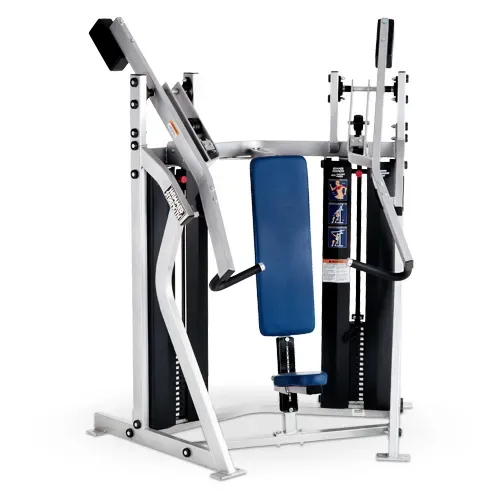
![Commercial ISO Lateral Leg Extension Machine for Gym Use [WARN] draft identifier mismatch](https://bicksport.com/wp-content/uploads/2026/08/commercial-iso-lateral-leg-extension-machine-for-gym-use-warn-draft-identifier-mismatch-6f635f.webp)
Continuous Load Verified — ISO-lateral independent arms and reinforced steel pivot assembly stress-tested for uninterrupted public facility use.
Technical Specifications
| Parameter | Value |
|---|---|
| Designation | H5036 |
| Product Type | ISO-Lateral Leg Extension Machine |
| Resistance Type | Selectorized weight stack |
| Movement System | ISO-lateral independent arm |
| Frame Material | Reinforced steel |
| Seat Adjustment | Multi-position ergonomic |
| Max User Weight | 180 kg |
| Product Dimensions | 1433 × 1477 × 1470 mm |
| Net Weight | 126 kg |
| Age Group | Adult |
| Gender | Unisex |
| Certification | ISO 9001, CE |
Application Suitability
| Deployment Scenario | Typical Use |
|---|---|
| Chain gym strength zone | High-frequency bilateral and unilateral leg conditioning across peak member hours |
| Community fitness center | Accessible lower-body training for diverse adult demographics throughout daily operation |
| Hotel and residential fitness facility | Compact footprint strength equipment positioned alongside cardio areas without noise transfer concerns |
| Corporate wellness room | Durable leg extension station for employee use during staggered break schedules |
| Sports performance training center | Balanced quad development supporting athlete programming with independent limb loading |
Why Pivot Drift and Frame Flex Undermine Leg Extension Stations
Rigid frame geometry and sealed bearing pivots maintain consistent resistance delivery under repeated daily loading cycles.
When a commercial ISO-lateral leg extension machine flexes under load or its pivot axis shifts after months of use, members feel uneven resistance through the range of motion. In public facilities where dozens of users cycle through a single station daily, this mechanical degradation accelerates. Lightweight frames paired with undersized bearings generate friction loss that manifests as sticking points mid-extension [NEED_CITE: commercial strength equipment pivot bearing duty cycles]. Facility operators then face member complaints about joint discomfort and inconsistent training feel — issues rooted in structural specification choices made at procurement.
Placement Within the Strength Training Layout
This commercial ISO-lateral leg extension machine serves the isolated quad development station in a structured lower-body training zone. It pairs with leg curl and hip sled stations to cover full posterior and anterior chain work without requiring members to transition to free-weight platforms. The unit accommodates a wide range of adult anthropometrics through adjustable seat depth and pad height settings. Its 1433 × 1477 mm footprint fits standard commercial spacing guidelines, allowing adjacent equipment placement without compromising ingress and egress clearance.
Operational Demands in Continuous-Access Facilities
In gymnasums operating 16 or more hours daily, selectorized stations experience rapid turnover between users with minimal downtime for equipment cooling or settling. The reinforced steel frame and commercial-grade pivot assembly on this unit are engineered for that turnover rhythm, maintaining alignment through repeated seat adjustments and load changes. Floor-leveling requirements matter here: an uneven substrate transfers lateral stress into the frame joints, accelerating bearing wear over time [NEED_CITE: EN 957 requirements for commercial strength equipment stability]. Facilities on upper floors or above occupied spaces benefit from the unit’s static-load design, which generates no vibration transfer during use — unlike plate-loaded alternatives where plate rattle transmits through floor structures. Standard single-phase power is not required, simplifying deployment in converted spaces without dedicated electrical circuits.
Selectorized Resistance and Independent Arm Mechanics
The ISO-lateral system decouples left and right leg movement, allowing unilateral loading that addresses strength asymmetries without requiring separate single-leg machines. Each arm operates on its own pivot axis with sealed bearings, delivering a smooth resistance arc from full flexion to full extension. The selectorized weight stack eliminates plate handling, reducing setup time between users and minimizing dropped-plate damage to surrounding flooring. Reinforced steel construction throughout the load path — from the weight stack guide rods through the cam assembly to the shin pad — ensures that resistance delivery remains consistent as cumulative usage hours accumulate. Unisex ergonomic pad positioning distributes contact pressure across the tibia, accommodating users of varying leg lengths without requiring manual pad swaps.
The Cost of Underspecified Pivot and Frame Components
Facilities that deploy leg extension machines with domestic-grade bearings and thin-wall steel tubing typically observe pivot play developing within the first year of commercial operation. That play introduces lateral wobble in the shin pad, creating uneven joint loading that members associate with knee discomfort. Weight stack guide rods in lighter constructions bend under repeated high-load drops, causing the selector pin to bind and the stack to hang unevenly [NEED_CITE: weight stack guide rod failure modes in commercial environments]. The cumulative effect is a station that members avoid, reducing return on floor space and prompting premature replacement cycles that compound procurement costs.
Engineering Choices Behind This Product Line
Every unit in this range undergoes 10,000-hour continuous cycle testing on frame welds and pivot assemblies before production release. The sub-35dB operational standard verified across the cardio line extends to strength equipment through sealed bearing specifications that eliminate metal-on-metal grinding noise. The ISO-lateral leg extension station occupies a defined footprint that integrates into 3D strength zone layouts — including equipment spacing, member flow paths, and sightline planning provided during the consultation phase. OEM customization extends to frame color, pad material, and weight stack increments, with console UI options available where digital tracking is specified. Full documentation accompanies each shipment, and 24/7 technical support covers commissioning questions and spare parts sourcing.
Documentation & Test Records
- CE declaration of conformity covering mechanical safety requirements
- EN 957 test report validating structural integrity and stability
- ISO 9001 certificate confirming manufacturing quality management
- Frame and pivot durability test record at 10,000-hour benchmark
- Selectorized weight stack calibration and guide rod specification sheet
- Installation guide with floor anchoring and leveling procedures
Installation, Commissioning & Maintenance
- Maintain minimum 600 mm clearance on all sides for user ingress and pad adjustment
- Level the reinforced steel frame on cured concrete substrate using adjustable foot plates
- Verify selectorized weight stack pin engagement and smooth travel during commissioning
- Inspect sealed pivot bearings quarterly for play and re-grease per maintenance schedule
- Wipe shin pad and seat surfaces with non-corrosive cleaner after each operating day
- Check frame weld joints at six-month intervals under continuous commercial deployment
Sizing and Specification Consultation
Provide the planned strength zone square footage and adjacent equipment list to receive a 3D layout incorporating this station’s footprint, member flow, and safe spacing requirements. Specify expected daily user volume so that pivot bearing duty cycle and weight stack capacity align with operational reality. Identify the deployment floor and any noise-sensitive adjacent spaces to confirm suitability. State the target market so that documentation language and compliance markings match local regulatory requirements.
Frequently Asked Questions
Q: What distinguishes ISO-lateral leg extension from plate-loaded alternatives in a commercial setting?
A: ISO-lateral independent arms allow unilateral loading without requiring separate single-leg machines, saving floor space. Selectorized weight stacks eliminate plate handling, reducing setup time between users and minimizing floor damage from dropped plates. The sealed pivot assembly requires less maintenance than plate-loaded hinge systems exposed to chalk dust and debris.
Q: How does frame construction affect equipment lifespan in high-traffic gym environments?
A: Reinforced steel frames with adequate wall thickness resist flex under repeated loading, preserving pivot alignment over thousands of use cycles. Thin-wall tubing develops fatigue cracks at weld junctions, particularly where the seat mount meets the main frame. Commercial-grade construction tested to 10,000-hour benchmarks prevents premature structural failure and member complaints.
Q: What maintenance do pivot bearings and weight stack systems require?
A: Sealed pivot bearings should be inspected quarterly for lateral play and regreased according to the manufacturer schedule. Weight stack guide rods need periodic cleaning to prevent chalk and dust buildup that causes selector pin binding. Both procedures are detailed in the commissioning guide provided with each unit.
Q: How should strength zone layout account for this equipment’s spatial requirements?
A: The 1433 × 1477 mm footprint requires surrounding clearance for user approach, seat adjustment, and safe egress under load. Placing the unit against a wall with adjacent open space on the entry side supports natural member flow. 3D layout planning incorporating sightlines ensures the station remains visible and accessible within the training zone.
![Commercial Squat Lunge Machine Gym Equipment for Professional Gyms [WARN] draft identifier mismatch](https://bicksport.com/wp-content/uploads/2026/08/commercial-squat-lunge-machine-gym-equipment-for-professional-gyms-warn-draft-identifier-mismatch-879872.webp)

