
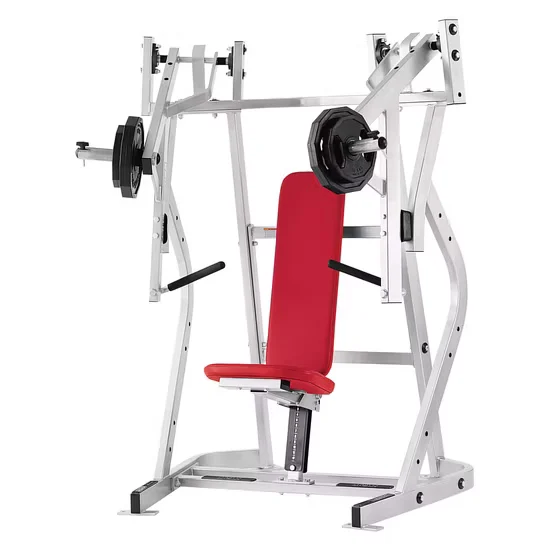
Steel Frame Stability — 140kg net weight and reinforced ISO-lateral structure resist resonance during high-frequency plate-loaded training.
Technical Specifications
| Parameter | Value |
|---|---|
| Product Type | ISO-Lateral Chest Press |
| Material | Steel |
| Exercise Part | Chest |
| Resistance Type | Plate-loaded / ISO-Lateral |
| Product Dimensions | 1323 × 1599 × 1746 mm |
| Net Weight | 140 kg |
| Foldable | Unfolded |
| Power Source | Manual |
| Age Group | Adult |
| Gender | Unisex |
| Customization | Available |
| Certification | ISO 9001, CE |
| HS Code | 9506911900 |
| Production Capacity | 500 PCS/Month |
Application Suitability
| Deployment Scenario | Typical Use |
|---|---|
| Chain gym strength zone adjacent to cardio area | High-frequency chest training with independent arm movement |
| Community fitness center mixed-layout floor | Durable plate-loaded resistance for diverse membership base |
| Hotel fitness center on guest room floors | Zero-noise manual operation eliminating motor-related disturbances |
| Corporate wellness room | Compact footprint accommodating bilateral and unilateral pressing |
| Sports performance training center | Athlete-grade biomechanical alignment for strength programming |
Why Vibration Complaints Start in the Weight Room Before the Treadmill Zone
Heavy-gauge steel and independent arm geometry isolate force transmission from the floor slab.
When a chain gym places a plate-loaded station next to an upper-floor cardio zone, the real noise complaint often originates from barbell drops and frame resonance — not the treadmill belt. Lighter frames amplify harmonic vibration through the concrete, reaching occupied rooms below long before maintenance notices anything [NEED_CITE: structural vibration transmission thresholds in multi-story fitness facilities]. I have seen facilities replace entire strength lines because the original units weighed under 100 kg and shook with every heavy set. A commercial ISO-lateral bench press machine plate-loaded chest unit at 140 kg net weight anchors itself against lateral sway, keeping energy in the movement path rather than in the building structure.
Independent Arm Geometry in a Mixed-Layout Strength Zone
This ISO-lateral chest press covers both bilateral and unilateral pressing patterns across moderate to heavy loading ranges. In a mixed cardio-and-strength floor plan, it pairs naturally with selectorized shoulder and back stations to complete an upper-body circuit without requiring members to cross the room. The commercial ISO-lateral bench press machine plate-loaded chest format fits high-traffic zones because there are no cables to snap and no electronics to reboot. Its footprint suits members of varying torso lengths, since the seat and arm pivot adjust independently.
Zero-Watt Footprint and What It Means for Floor Deployment
With no motor, no console, and no power cable, this station runs entirely on plate-loaded resistance — meaning zero electrical infrastructure is required. In hotel fitness centers on guest room floors, eliminating powered units from the strength cluster reduces total ambient noise to the sound of plates clicking onto the horns [NEED_CITE: ambient noise benchmarking in hospitality fitness centers]. Ventilation requirements drop because there is no motor heat to dissipate. Floor leveling remains important: a 140 kg frame on an uneven slab will rock, transferring vibration into the structure. A simple rubber mat under each foot is usually sufficient.
Plate-Loaded Mechanics and Frame Load Path
The ISO-lateral design means each arm pivots independently on its own axis, allowing the pressing arc to follow the natural convergence of the pectoral fibers rather than forcing a fixed bar path. Plate-loaded resistance provides a linear load curve — what you load is what you lift, with no selector pin friction or cable pulley losses to account for. The 1323 × 1599 × 1746 mm steel frame creates a wide base polygon, resisting tipping even when one horn is loaded significantly heavier than the other during unilateral work. Grip positions and seat back angle are fixed by the weld geometry, so the buying decision rests on whether that arc suits the target membership’s anthropometrics [NEED_CITE: ISO-lateral press arc alignment with population anthropometric data].
The Hidden Cost of Undersized Strength Frames
Facilities that spec 80 kg bench stations to save freight costs often face premature bearing wear and wobble within the first year of commercial use. Members notice the shake during heavy sets and migrate to the free-weight bench, leaving the machine underused and the investment wasted [NEED_CITE: member attrition patterns linked to equipment perceived instability]. In hotel deployments, a light frame on an upper floor transmits vibration downward, triggering the same guest complaints that cardio noise usually causes. Upgrading to a 140 kg unit at procurement eliminates both problems at once.
Why This Line Fits a Single-Source Cardio-and-Strength Procurement
The 10,000-hour durability standard applied across the cardio family extends to structural testing on strength frames as well — weld integrity and bearing lifespan are validated under cyclic loading protocols. Full OEM and ODM options include frame color and logo placement, so the strength station visually matches the treadmill and elliptical consoles in a unified deployment. The free 3D layout service covers this unit’s clearance envelope, ensuring safe passage behind the seat and adequate horn-loading space on each side. Twenty-four-seven technical support applies across the entire order, meaning one point of contact for every discipline in the room.
Documentation & Test Records
- CE declaration of conformity covering plate-loaded strength equipment
- EN 957 test report validating structural load and stability requirements
- ISO 9001 certificate for manufacturing quality management
- Weld inspection and frame load-path test records
- Surface coating adhesion and corrosion resistance report
- Installation guide with floor anchoring and clearance specifications
Installation, Commissioning & Maintenance
- Maintain 600 mm clearance behind the 1599 mm frame depth for plate loading access
- Place vibration-damping mats under all four feet on upper-floor deployments
- Verify floor levelness within 3 mm across the 1323 mm width before final positioning
- Inspect pivot bearings for smooth travel during commissioning before opening to members
- Wipe steel surfaces with pH-neutral cleaner weekly to prevent sweat-induced corrosion
- Check horn sleeve retention bolts quarterly under high-frequency commercial use
Sourcing the Right Strength Station for Your Floor Plan
Provide the total strength-zone square footage and adjacent cardio equipment list to receive a 3D layout that accounts for plate-loading clearance and member flow around this unit. Specify whether the deployment sits on an upper floor to confirm vibration isolation requirements. Indicate target market region so surface treatment and labeling meet local compliance standards. State whether frame color and logo customization are needed to match existing cardio equipment finishes.
Frequently Asked Questions
Q: How does ISO-lateral movement differ from a fixed-path chest press?
A: ISO-lateral arms pivot independently, allowing each side to follow a natural converging arc that matches pectoral fiber orientation. Fixed-path machines force both arms along a single track, which can create shoulder discomfort for users with wider or narrower frames. The independent design also permits unilateral loading for rehabilitation or strength-imbalance correction without requiring a separate station.
Q: What maintenance does a plate-loaded station require compared to selectorized equipment?
A: Plate-loaded stations have no cables, pulleys, or weight-stack guide rods to inspect. Maintenance is limited to pivot bearing lubrication, horn sleeve bolt checks, and surface cleaning. Selectorized units require cable tension adjustments and pin mechanism servicing on a regular schedule. The simpler mechanical path of a plate-loaded design typically results in lower lifetime maintenance cost and fewer service interruptions.
Q: How do you control vibration when placing heavy strength equipment above occupied floors?
A: Frame mass is the first line of defense — a 140 kg unit absorbs more energy than a lighter frame before transmitting vibration into the slab. Rubber isolation mats under each foot decouple the structure from the concrete. Floor leveling within tight tolerances prevents rocking. Combined, these measures reduce transmitted vibration to levels typically acceptable in hospitality environments above guest room floors.
Q: How should commercial facilities match equipment durability to daily usage frequency?
A: Facilities open sixteen or more hours per day need frames and bearings rated for continuous high-frequency cycling rather than light-commercial duty. Verify that weld joints and pivot points have been tested under cyclic loading protocols comparable to actual member throughput. Underspecifying durability for the expected volume leads to premature bearing wear, structural wobble, and unplanned downtime that disrupts member experience.
![Commercial Seated Bicep Curl Machine for Gym Fitness Equipment [result]Commercial Seated Bicep Curl Machine for Gym Fitness Equipment[/result]](https://bicksport.com/wp-content/uploads/2026/08/commercial-seated-bicep-curl-machine-for-gym-fitness-equipment-resultcommercial-seated-bicep-curl-machine-for-gym-fitness-equipment-result-26fa2c.webp)


![Hammer Strength Equipment OS-H5055 Deluxe Weight Tree for Commercial Gym Plate Storage [WARN] draft identifier mismatch](https://bicksport.com/wp-content/uploads/2026/08/hammer-strength-equipment-os-h5055-deluxe-weight-tree-for-commercial-gym-plate-storage-warn-draft-identifier-mismatch-20ff2a.webp)