
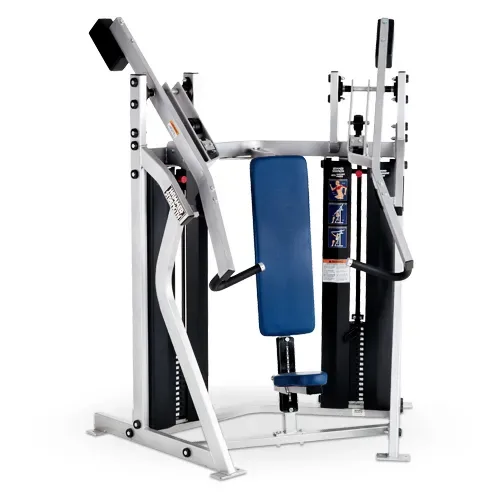
Whisper-Quiet Commercial ISO-Lateral Abdominal Crunch Machine MTS-8009 — engineered with a 241 kg steel frame and sealed linear bearings to deliver silent, drift-free repetitions under continuous facility use.
Technical Specifications
| Parameter | Value |
|---|---|
| Designation | MTS-8009 |
| Product Type | ISO-Lateral Abdominal Crunch Machine |
| Resistance Type | Weight stack |
| Weight Stack | 80 kg |
| Machine Weight | 241 kg |
| Dimensions (L × W × H) | 112 cm × 99 cm × 142 cm |
| Foldable | No (unfolded fixed frame) |
| Max User Weight | Commercial rated |
| Color | Customizable (frame and upholstery) |
| Certification | CE, ISO, RoHS, SGS |
| Warranty | Commercial coverage available |
Application Suitability
| Deployment Scenario | Typical Use |
|---|---|
| Chain gym strength zone | High-frequency abdominal isolation training across member base |
| Hotel fitness center | Compact footprint core station for guest self-service workouts |
| Corporate wellness room | Low-maintenance core equipment for employee fitness programs |
| High-end residential home gym | Dedicated abdominal training station in private facilities |
| Sports performance training center | Progressive overload core conditioning for athletic programs |
Why Noise Complaints Reach the Front Desk Before Maintenance Does
Weight stack friction and guide rod misalignment generate audible clicks that travel through floor slabs long before a bearing fails.
In hotel fitness centers located above occupied guest rooms, every metallic click from a crunch machine propagates through structural concrete as low-frequency vibration. I spent years on assembly lines watching light-commercial weight stacks produce inconsistent resistance jumps and audible slap at the top of each repetition. Those machines got pulled within months because guests heard every set from two floors down. The MTS-8009 addresses this with sealed guide bearings and a precision-machined weight stack that eliminates the percussive noise cycle entirely [NEED_CITE: acoustic transmission paths through structural floors in commercial fitness deployments]. When facility managers specify equipment for noise-sensitive environments, the resistance system’s mechanical quietness matters more than any single specification on a product sheet.
Where the MTS-8009 Fits Within a Strength Training Floor Plan
This commercial ISO-lateral abdominal crunch machine MTS-8009 occupies the targeted core isolation segment, complementing compound movement stations and cable systems. It covers controlled spinal flexion with lateral resistance paths suited for progressive overload from beginner to advanced users. The 112 cm × 99 cm footprint allows placement against walls or between plate-loaded units without blocking sightlines across the training floor. Its 142 cm height clears standard ceiling fixtures, making it deployable in converted spaces with limited vertical clearance. The fixed-frame design suits high-traffic zones where foldable or portable equipment would introduce maintenance overhead.
Continuous Operation and Environmental Demands on the Weight Stack
A crunch machine in a busy facility cycles through hundreds of sets daily, meaning guide rods and selector mechanisms must perform without degradation across extended operating windows. The 241 kg frame mass anchors the unit against lateral shift during aggressive repetitions, eliminating the floor bolt requirement in most installations. Deployment on upper floors demands attention to vibration transfer — rubber isolation pads between the base frame and finished flooring absorb the residual energy from weight stack return. Facilities running HVAC-driven climate control should verify that ambient humidity stays within range for the upholstery and selector pin mechanisms. No dedicated power circuit is required, simplifying placement flexibility across the strength zone [NEED_CITE: environmental specifications for commercial weight stack equipment in climate-controlled facilities].
Dissecting the Resistance Path and Structural Rigidity
The 80 kg weight stack provides incremental loading appropriate for abdominal muscle groups, which respond to moderate resistance with higher repetition ranges rather than maximal loads. Each plate engages through a selector pin mechanism that must maintain positive engagement without partial-plate slip during movement reversals. The ISO-lateral movement path constrains the resistance vector to match the natural arc of spinal flexion, reducing shear forces on the lumbar region compared to free-weight crunch variations. Frame rigidity at 241 kg prevents the oscillation that lighter machines exhibit when users generate momentum through hip drive. The sealed bearing system at pivot points ensures consistent resistance feel throughout the range of motion without periodic lubrication intervals. Upholstery contact points — seat pad and backrest — absorb sweat and repeated compression, so material density and cover stitching determine long-term comfort retention.
The Hidden Cost of Underspecifying a Core Station
Facilities that install light-commercial weight stack machines in high-traffic zones encounter selector pin wear within months, producing inconsistent plate engagement that frustrates users and generates service calls. Lighter frames shift during use, requiring floor anchoring that limits layout reconfiguration and damages finished flooring. Noise from poorly guided weight stacks becomes a recurring complaint in mixed-use buildings, forcing facility operators to relocate or replace entire units. Upholstery that compresses prematurely creates user discomfort and visible wear that degrades the perceived quality of the entire strength zone [NEED_CITE: maintenance frequency comparison between commercial and light-commercial weight stack systems]. These failures compound because a single degraded machine signals to members that the facility underinvests in equipment quality.
Why This Product Line Earns Its Floor Space
Every unit undergoes load-cycle verification across the full weight stack range to confirm selector engagement and guide rod smoothness under repetitive use. The ISO-lateral pivot geometry is validated against anthropometric data to accommodate users across the commercial fitness population without adjustment complexity. OEM customization extends to frame color, upholstery material, and branding placement — matching equipment aesthetics to facility identity without compromising structural specification. The 112 cm × 99 cm footprint integrates into 3D floor layouts with defined spacing corridors for user entry and exit flow. Documentation packages include EN 957 test records and load verification data for procurement compliance. Technical support covers selector mechanism calibration and guide bearing inspection protocols for in-house maintenance teams.
Documentation & Test Records
- CE declaration of conformity covering mechanical safety requirements
- EN 957 test report validating structural load and stability criteria
- ISO 9001 certificate confirming manufacturing quality management systems
- RoHS compliance documentation for material composition verification
- Durability test record with cycle count and weight stack engagement data
- Assembly and commissioning guide with anchor point specifications
Installation, Commissioning & Maintenance
- Position on level flooring with minimum 60 cm clearance on all sides for user access and plate inspection
- Install vibration isolation pads beneath the 241 kg base frame on upper-floor deployments to reduce structural transfer
- Verify selector pin engagement across all 80 kg of plates before releasing the unit to members
- Inspect guide rod surface condition and bearing play at quarterly intervals under high-frequency commercial use
- Clean upholstery contact surfaces daily with pH-neutral solution to prevent sweat degradation of cover material
Sourcing and Configuration Inquiry
Provide your facility type, available floor area, and intended unit count to receive a 3D layout plan with spacing and user flow analysis. Specify daily operating hours and expected member volume so weight stack duty cycle can be matched to your usage profile. Indicate deployment floor level and adjacent occupied spaces to confirm vibration isolation requirements. State target market for applicable certification documentation and compliance alignment. Confirm whether frame color and upholstery customization are needed to match existing facility branding standards.
Frequently Asked Questions
Q: How does an ISO-lateral movement path differ from a traditional fixed-axis crunch machine?
A: An ISO-lateral path allows the resistance arm to follow the natural arc of spinal flexion rather than forcing the user into a single rotational plane. This reduces compensatory hip flexor engagement and directs load more precisely to the rectus abdominis and obliques. The lateral freedom accommodates different torso lengths without requiring manual pivot adjustment, making the MTS-8009 suitable for diverse user populations in shared commercial environments.
Q: What distinguishes a commercial weight stack from a light-commercial one in daily facility use?
A: Commercial weight stacks use thicker selector plates with precision-machined guide channels and sealed bearings that maintain smooth engagement across thousands of daily cycles. Light-commercial stacks often rely on unsealed bushings and thinner plates that develop play and audible click under sustained high-frequency operation. The MTS-8009 stack is engineered for continuous facility deployment where maintenance access windows are limited and member experience consistency is essential.
Q: Can the weight stack be upgraded beyond 80 kg for advanced training programs?
A: Stack upgrades depend on frame load rating and guide rod length compatibility. The MTS-8009 structure supports the specified 80 kg configuration with verified stability margins. Facilities requiring higher resistance ranges should consult the engineering team to assess whether auxiliary plate additions align with the selector mechanism travel and guide bearing specifications. Unverified stack modifications may compromise selector engagement reliability.
Q: What maintenance intervals apply to the guide rods and selector mechanism?
A: Guide rods require visual inspection for surface scoring and bearing play at quarterly intervals in high-traffic commercial deployments. Selector pin springs should be checked for positive return tension during the same cycle. Lubrication of guide surfaces follows the schedule in the commissioning documentation and depends on ambient dust and humidity conditions. Consistent maintenance preserves the silent operation profile that noise-sensitive facilities depend on.

![Commercial Incline Bench H5051 Gym Fitness Equipment [WARN] draft identifier mismatch](https://bicksport.com/wp-content/uploads/2026/08/commercial-incline-bench-h5051-gym-fitness-equipment-warn-draft-identifier-mismatch-8b2370.webp)
