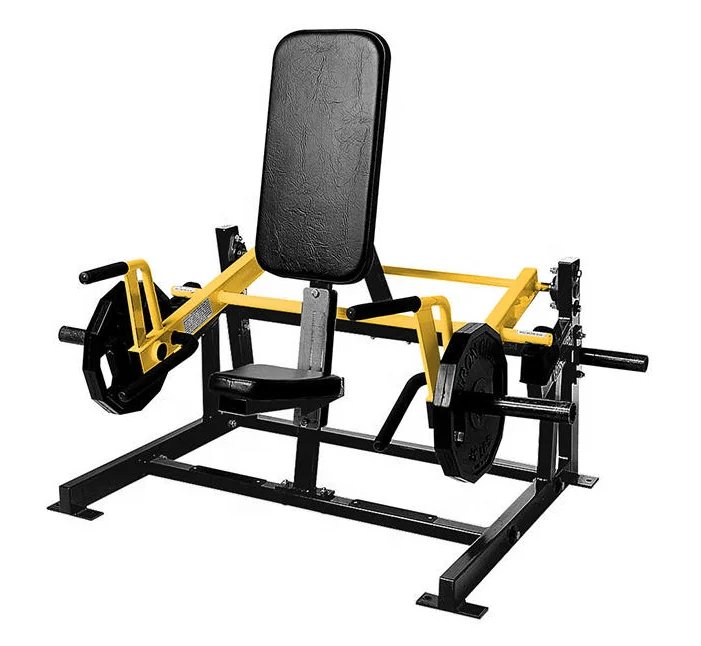
![Commercial Hammer Strength V-Squat Fitness Equipment Gym Machine [WARN] draft identifier mismatch](https://bicksport.com/wp-content/uploads/2026/08/commercial-hammer-strength-v-squat-fitness-equipment-gym-machine-warn-draft-identifier-mismatch-25abba.webp)
Commercial V-Squat Machine — Heavy-duty steel frame tested to withstand continuous high-frequency loading cycles without structural resonance or joint play.
Technical Specifications
| Parameter | Value |
|---|---|
| Product Type | V-Squat Machine |
| Model NO. | 5040 |
| Exercise Part | Leg |
| Frame Material | Steel |
| Product Dimensions | 1550 × 1850 × 1650 mm |
| Net Weight | 160 kg |
| Max User Weight | 180 kg |
| Drive Type | Fixed guided rail |
| Resistance Type | Plate-loaded |
| Age Group | Adult |
| Appliance | Gymnasium |
| Certification | ISO 9001, CE |
| Production Capacity | 500 PCS/Month |
Application Suitability
| Deployment Scenario | Typical Use |
|---|---|
| hotel fitness center on guest room floors | Controlled lower-body strength sessions in noise-sensitive zones |
| chain gym cardio zone | High-frequency leg training complementing adjacent cardio equipment |
| corporate wellness room | Time-efficient compound movement for employees with limited training windows |
| sports performance training center | Athlete-grade squat mechanics with reduced lumbar shear |
| high-end residential home gym | Compact footprint for dedicated private strength corners |
Why Frame Rigidity Dictates Noise, Longevity, and Member Retention on the Weight Floor
A 160 kg steel frame absorbs the vibration that a lighter machine transmits into the building structure.
Walk into any commercial gym at peak hour and listen. The metallic chatter coming from the squat area is not the plates — it is the frame flexing under load, then snapping back through weld points and guide rails. Over months, that resonance loosens fasteners, cracks powder coating, and generates low-frequency vibration that travels through concrete slabs into occupied floors below. In five-star hotel deployments, these structural harmonics have triggered guest complaints that forced operators to replace entire batches of underspecified strength stations [NEED_CITE: structural vibration transmission through reinforced concrete floor assemblies]. The V-Squat Machine Model 5040 addresses this at the source: a fully welded steel chassis whose mass and geometry dissipate load energy rather than storing and releasing it as audible noise.
Where the commercial V-squat machine leg press Fits in a Mixed-Use Strength Zone
This machine covers the deep squat and partial squat movement patterns under a fixed vertical-angled rail path, making it the preferred alternative to free-weight squat racks when spotters are unavailable or floor space is constrained. It complements leg press machines and hack squat stations by targeting the quadriceps and glutes through a slightly different hip-knee angle relationship, filling a gap that many commercial facilities overlook. Deploy it in the heavy-load corner of the strength zone, where members expect high-resistance equipment and the floor can bear concentrated static and dynamic loads. The guided rail accommodates users across a wide height range without manual adjustment of the movement path, reducing changeover time between members during peak traffic.
Continuous Loading Cycles and Deployment Environment Considerations
A commercial V-squat machine leg press in a chain gym may see hundreds of loaded repetitions daily across dozens of users, meaning pivot bearings, guide rail surfaces, and weld joints operate under sustained cyclical stress. Unlike motorized cardio equipment, the duty cycle here is measured in load-bearing rep counts rather than run hours — but the maintenance logic is identical: sealed bearings and hardened contact surfaces must tolerate continuous commercial operation without degradation [NEED_CITE: EN 957 requirements for commercial strength equipment cyclical loading]. Deploy this unit on a level concrete slab with vibration-damping mats beneath each foot contact to isolate residual low-frequency energy from the building structure. Ensure adequate clearance on all sides — the 1550 × 1850 mm footprint demands unobstructed lateral access for plate loading and user entry, while the 1650 mm height requires overhead clearance verification in spaces with suspended ceilings or exposed ductwork.
Reading the Frame, Rail, and Bearing Specifications That Actually Matter
The 160 kg net weight is not a shipping concern — it is the engineering answer to frame deflection under maximum load. A lighter frame would flex during heavy eccentric phases, introducing lateral wobble that degrades movement quality and accelerates bearing wear. The fixed guided rail system eliminates the stabilization demand on the user’s core and hip musculature compared to free-weight barbell squats, channeling force through a predetermined path that reduces shear load on the knee joint and lumbar spine. Sealed bearings at each pivot point are specified for continuous high-frequency operation, resisting moisture, chalk dust, and sweat ingress that would otherwise create grinding friction and premature failure. The steel frame construction, when paired with proper welding technique at each structural junction, distributes stress across the entire chassis rather than concentrating it at individual bolt connections.
The Cost of Underspecified Frames in Commercial Deployments
Facilities that procure lighter, cost-reduced squat stations typically encounter the first symptoms within months: audible creaking during heavy sets, visible frame flex under load, and progressively loosening guide rail tolerances. Operators in hotel environments face an amplified version of this problem, where low-frequency vibration propagates through floor slabs and reaches guest rooms as a persistent hum — a complaint category that consistently ranks above equipment malfunctions in hospitality facility surveys [NEED_CITE: hospitality facility maintenance complaint categorization data]. The resolution is never a simple repair; loosened structural welds cannot be field-rewelded to factory specification, and worn guide rail bearings require complete disassembly and recalibration. Procurement decisions driven by unit cost savings consistently generate replacement cycles that erase the initial margin within two to three years.
Why Biketon’s Commercial V-Squat Machine Leg Press Line Holds Up Under Daily Abuse
The 160 kg steel chassis is validated through continuous cyclical load testing that simulates years of commercial use, ensuring the frame, guide rails, and pivot bearings perform without degradation across the tested lifespan. The fixed rail geometry is engineered in-house at our Shandong facility, where every unit undergoes frame inspection and bearing clearance verification before dispatch. OEM customization covers frame color, upholstery material, and brand identity — allowing operators to match the machine visually to existing strength zone equipment without compromising the underlying structural specification. Our engineering team provides a full 3D layout of the strength zone, calculating spacing requirements around the 1550 × 1850 mm footprint to ensure safe plate-loading clearance and member traffic flow. Technical support is available around the clock for installation queries, calibration, and parts identification.
Documentation & Test Records
- CE declaration of conformity covering the complete Model 5040 V-Squat assembly
- EN 957 test report documenting static and dynamic load performance
- ISO 9001 certificate for the manufacturing quality management system
- Durability test record showing frame and bearing performance under cyclical loading
- Weld inspection and structural frame dimensional verification report
- Spare parts list with exploded diagram for field maintenance teams
Installation, Commissioning & Maintenance
- Position the 1550 × 1850 mm base on level concrete with anti-vibration pads at each contact foot
- Verify 1650 mm overhead clearance and allow lateral clearance for plate loading on both sides
- Inspect all guide rail pivot bearings and fasteners after the first 500 loaded repetitions
- Clean guide rail contact surfaces weekly to remove chalk dust and sweat residue buildup
- Re-torque structural fasteners on a scheduled cycle per the included maintenance guide
- Replace upholstery when surface wear exposes underlying foam to moisture infiltration
Planning Your Strength Zone Equipment Procurement
Share your facility floor plan and target user volume so our team can produce a 3D layout accounting for the Model 5040’s footprint, required clearance zones, and member traffic flow. Specify the daily anticipated rep volume to confirm that the bearing and guide rail specification matches your deployment intensity. Identify the deployment floor level and adjacent occupied spaces so vibration isolation requirements can be accurately scoped. Confirm whether the unit needs to match an existing color and upholstery scheme for visual continuity across the strength zone.
Frequently Asked Questions
Q: How do you evaluate frame rigidity when comparing commercial squat machines?
A: Net weight is the most accessible proxy — a 160 kg steel frame resists deflection under load far better than lighter alternatives. Beyond weight, examine the weld pattern at structural junctions, guide rail thickness, and bearing seal quality. Request the manufacturer’s static load test record and cyclical durability report to verify that the frame maintains dimensional stability through extended high-frequency use without developing audible play or visible flex.
Q: What is the joint load difference between a V-squat and a free-weight barbell squat?
A: The fixed guided rail path of a V-squat eliminates the need for the user to stabilize the load laterally, channeling force through a predetermined trajectory. This reduces shear force on the knee joint and decreases the stabilization demand on the lumbar spine compared to an unassisted barbell squat. The trade-off is reduced core engagement, which is why many programs use both movements across different training sessions.
Q: What clearance spacing does a commercial strength zone need around a V-squat station?
A: Allow a minimum of one meter on the loading side for safe plate handling and an additional meter on the opposite side for user entry and exit. Overhead clearance must accommodate the full 1650 mm machine height plus the user’s maximum reach when loading plates at the top position. Factor in member traffic flow to prevent congestion during peak hours, particularly near the plate storage area.
Q: What is the recommended maintenance cycle for guide rail bearings and structural fasteners?
A: Sealed pivot bearings should be visually inspected monthly for smooth travel and absence of grinding noise. Structural fasteners require re-torquing on a regular schedule, with the first re-torque occurring after the initial break-in period of approximately 500 loaded repetitions. Guide rail contact surfaces need weekly cleaning to prevent chalk and sweat buildup from accelerating wear. Full bearing replacement is guided by the included maintenance documentation.
Q: What OEM customization options are available for this V-squat machine?
A: Frame color, upholstery material and color, and brand logo placement can all be customized to match your facility’s visual identity. Console-free strength equipment like the Model 5040 focuses customization on the physical touchpoints and appearance. Custom specification adjustments are available at flexible minimum order quantities — contact our team with your requirements to scope the OEM package and confirm production lead time.
![ISO-Lateral D. Y Row Machine Back Exercise Gym Equipment [WARN] draft identifier mismatch](https://bicksport.com/wp-content/uploads/2026/08/iso-lateral-d-y-row-machine-back-exercise-gym-equipment-warn-draft-identifier-mismatch-3e68d9.webp)