
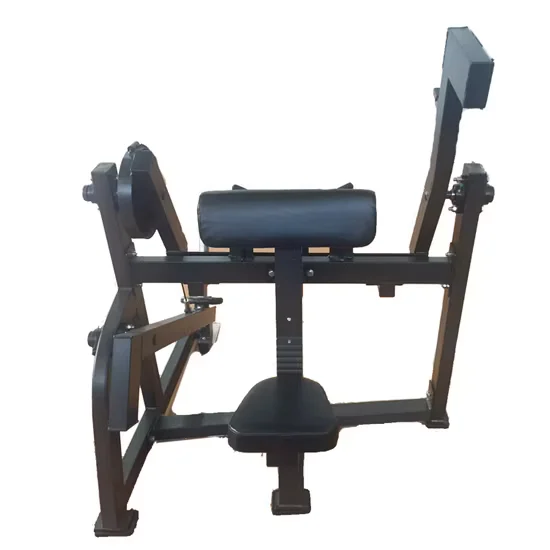
Continuous Duty Verified — every pivot and bearing on this machine completes a 10,000-hour cycle before leaving the Shandong factory.
Technical Specifications
| Parameter | Value |
|---|---|
| Designation | OS-H5013 |
| Product Type | Hammer Strength Seated Biceps Machine |
| Frame Material | Steel |
| Net Weight | 136 kg |
| Product Dimensions | 1455 × 1475 × 2133 mm |
| Max User Weight | 180 kg |
| Seat Adjustment | Multi-position |
| Grip Options | Rotating handles |
| Color | Optional |
| OEM / ODM | Available |
| Certification | ISO 9001, CE |
Application Suitability
| Deployment Scenario | Typical Use |
|---|---|
| Hotel fitness center on guest room floors | Self-guided arm isolation for early-morning and late-night guests |
| Chain gym cardio zone perimeter | Complementary strength station between cardio and free-weight areas |
| Corporate wellness room | Quick-access upper-body work during short break windows |
| High-end residential home gym | Dedicated bicep station replacing adjustable dumbbell racks |
| Sports performance training center | Controlled hypertrophy work within periodized athlete programs |
Why Pivot Bearings Fail Before the Frame Does on a Commercial Hammer Strength Seated Biceps Machine
Sealed cartridge bearings carry the load that open bushings cannot survive past the first year.
A seated curl machine sees thousands of asymmetric reps weekly. Unlike a leg press where force aligns with the pivot, bicep work drives lateral torque into every joint in the linkage. When that linkage rides on open bushings instead of sealed bearings, wear creates play, the movement path drifts, and members feel a grind they cannot name but will not return to repeat [NEED_CITE: bearing life classification under asymmetric lateral loading in strength equipment]. The OS-H5013 routes all pivots through sealed units so the arc the engineer drew on day one is the arc a member feels on day one thousand.
How the Hammer Strength Seated Biceps Machine Fits Inside a Full Strength Floor
This station occupies the isolation end of the upper-body spectrum. It pairs with a preacher curl for variety and sits downstream of compound pullers like lat machines and seated rows, letting members finish a back-and-arm circuit without changing zones. The fixed movement path suits all experience levels, from first-time hotel guests to coached athletes working controlled negatives.
The 1455 × 1475 mm footprint leaves clearance for plate loading on both sides while keeping the aisle behind open for member flow. Rotating handles and a multi-position seat let users from the fifth to the ninety-fifth percentile find a natural elbow axis without forcing the shoulder into compensation.
Continuous Use and the Facility Environment Around the Machine
A 136 kg steel frame resists walking and tipping during heavy negatives, but mass alone does not solve deployment. The unit must sit on a level surface with rubber isolation pads to stop vibration transmission into the slab — particularly relevant when the strength room shares a floor with guest corridors or treatment rooms [NEED_CITE: vibration transmission through concrete slabs under cyclic point loads].
Overhead clearance of at least 2400 mm accommodates the 2133 mm frame height plus safe hand clearance during plate changes. Ambient temperature matters for grip surfaces and upholstery; the seat pad spec assumes a climate-controlled 18–24 °C zone, not an unconditioned garage bay. Power is not required, so placement is limited only by member sightlines and plate-storage adjacency.
What the Steel Mass and Pivot Geometry Actually Deliver
The 136 kg net weight anchors the frame against the lateral forces generated when a member loads one side of the movement arm heavily. Lighter frames shift during negatives, forcing the user to stabilize the machine instead of working the target muscle.
Sealed cartridge bearings at every pivot keep the resistance curve consistent across the full range of motion. Open bushings, common on lower-tier units, develop radial play that translates into a dead spot at the top of the curl where gravity should be providing peak tension.
Rotating handles follow the natural forearm supination that occurs during elbow flexion. Fixed bars force the wrist into ulnar deviation under load, concentrating stress on the medial elbow.
The multi-position seat moves the user’s elbow axis in line with the machine’s pivot axis. Misalignment between those two points turns a pure bicep curl into a shoulder-front-deltoid hybrid.
The Cost Hidden Inside a Lighter Bicep Station
Spec a 90 kg curl machine for a chain gym and the frame will not fail — the pivot points will. Bushings wear into oval bores, the arm develops lateral play, and the stack or plate horn begins to chatter. Members do not submit maintenance tickets; they simply stop booking the machine.
Upholstery on lighter units tends to compress and split along the stitch line within the first year of high-frequency use, leaving exposed foam that absorbs sweat and fails hygiene audits. Replacement pads cost less than a new machine, but the downtime and reupholstery labor compound into a figure that exceeds the original price gap between tiers [NEED_CITE: upholstery lifecycle under commercial sweat and UV exposure].
Voltage is irrelevant on a selectorized or plate-loaded unit, but floor-flatness tolerance is not. A frame that lacks adjustable leveling feet will rock on imperfect concrete, accelerating asymmetric bearing wear.
Why This Product Line Covers the Bicep Station and the Rest of the Floor
Every pivot on the OS-H5013 runs sealed cartridge bearings, the same spec used across the full six-series cardio and strength catalog, so maintenance intervals align across the floor.
The 10,000-hour durability protocol applied to motors on the treadmill line is mirrored here as cycle-count testing on the linkage, validating the movement path under sustained asymmetric load.
Color and OEM graphics are configurable from a single source, meaning the bicep station, the leg press, and the treadmill bank can ship in a unified palette with matched console fascia and logo placement.
A free 3D layout accounts for the 1455 × 1475 mm footprint plus the plate-loading envelope on each side, preventing the common mistake of placing this unit flush against a wall where members cannot load safely.
24/7 technical support covers bearing replacement and upholstery refresh, keeping the station in rotation instead of tagged out of service.
Documentation & Test Records
- CE declaration of conformity covering the OS-H5013 frame and pivot assembly
- EN 957 test report validating static and cyclic load on the movement arm
- ISO 9001 certificate for the manufacturing facility
- Bearing lifecycle test record under asymmetric lateral loading
- Upholstery abrasion and sweat-resistance test data
- Dimensional drawing with leveling and anchoring details
Installation, Commissioning & Maintenance
- Maintain minimum 600 mm clearance on each side for plate loading on the OS-H5013
- Place rubber isolation pads under all four feet to decouple vibration from the slab
- Level the frame with adjustable feet before tightening pivot bolts to final torque
- Inspect sealed bearings at six-month intervals and replace as a cartridge set
- Wipe rotating handles with neutral pH cleaner after each operational shift
- Check upholstery stitch lines quarterly and schedule reupholstery before foam exposure
Request a Facility-Specific Equipment Layout
Provide the strength-zone floor area and the planned unit count to receive a 3D layout that accounts for the plate-loading envelope and member flow around each bicep station.
Specify the deployment floor and the spaces directly below or adjacent so the isolation-pad requirement can be confirmed.
State the target market and whether the facility will integrate usage tracking, so the correct documentation package ships with the units.
Frequently Asked Questions
Q: What structurally separates a commercial bicep machine from a home-gym version?
A: Home units use open bushings and thinner-gauge steel that tolerate a few hundred reps per week. Commercial stations require sealed cartridge bearings and a frame mass that resists lateral drift under continuous asymmetric loading, which is why the OS-H5013 is built at 136 kg with bearing pivots at every joint.
Q: How often do the pivot bearings need servicing?
A: Sealed cartridge bearings require no routine lubrication. Inspect them at six-month intervals for lateral play by applying side load to the movement arm with no weight on the stack or horn. Replace the cartridge as a complete unit when play becomes detectable, which under typical gym volume takes multiple years.
Q: What is the maximum user weight this station supports?
A: The commercial range is rated for users up to 180 kg. This figure accounts for the dynamic forces generated during heavy negatives, not just static body weight, and is validated through cyclic load testing per EN 957 requirements.
Q: How should the strength floor be planned around this machine?
A: Allow the 1455 × 1475 mm footprint plus a minimum of 600 mm on each side for safe plate loading. Position the station so the member faces the open floor rather than a wall, maintaining sightlines across the zone and preventing a bottleneck at the plate-storage area.


