
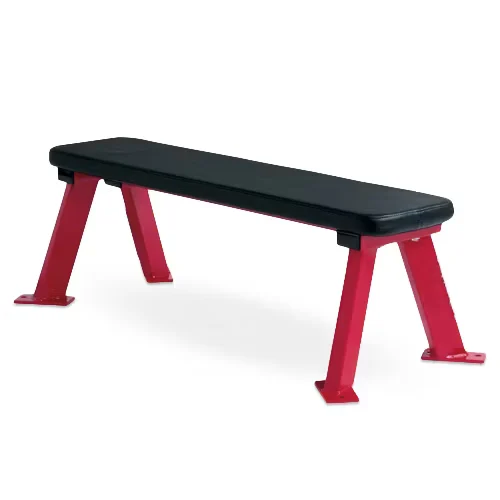
Rigid Frame Engineering — 50×100×3mm steel tube construction with 230kg mass delivers the stability required for heavy pressing under continuous commercial use.
Technical Specifications
| Parameter | Value |
|---|---|
| Designation | SRH-34 |
| Product Type | Hammer Strength Flat Bench |
| Tube Size | 50×100×3mm |
| Material | Iron |
| Machine Weight | 230kg |
| Product Dimensions | 2440×1920×1615mm |
| Folded | Unfolded |
| Power Source | Manual |
| Exercise Part | Arm |
| Age Group | Adult |
| Gender | Unisex |
| Certification | RoHS, ISO 9001, CE |
| Production Capacity | 200 Pieces/Month |
| Customization | Available (color, specifications, branding) |
Application Suitability
| Deployment Scenario | Typical Use |
|---|---|
| Chain gym strength and free-weight zone | High-frequency pressing movements throughout operating hours |
| Community fitness center | Shared bench press and dumbbell work for diverse member base |
| Corporate wellness room | Compact deployment for employee strength training programs |
| High-end residential home gym | Dedicated pressing station with commercial-grade durability |
| Sports performance training center | Barbell and dumbbell pressing for athlete conditioning |
Why Frame Rigidity Matters More Than Padding Thickness
A 50×100×3mm steel tube frame eliminates the wobble that compromises heavy pressing sessions.
I have seen lightweight benches in commercial gyms develop visible weld fatigue within a year. The uprights start to flex under loaded barbells, the seat pad shifts on its mounts, and spotters lose confidence in the platform beneath the lifter. The commercial hammer strength flat bench addresses this at the structural level rather than through cosmetic upgrades. A 230kg chassis mass means the unit stays planted during aggressive repetitions without requiring floor anchors. [NEED_CITE: structural fatigue thresholds for commercial strength equipment frames]
Positioning Within a Commercial Free-Weight Layout
This unit fills the dedicated flat-press station role in a strength zone layout. It pairs with incline and decline counterparts to cover the full pressing spectrum. The 2440×1920mm footprint demands clear lateral spacing for barbell loading and spotter positioning. It accommodates users across a broad height range through its fixed geometry and wide pad profile. The commercial hammer strength flat bench serves as a primary compound-lift anchor rather than an accessory station.
Floor Loading and Placement Environment Requirements
A 230kg unit concentrates load on four contact points, requiring verified slab capacity before deployment on upper floors. Rubber matting beneath the frame dampens barbell vibration transfer to adjacent spaces. Level flooring is essential — even minor tilt introduces lateral drift under asymmetric loads. Ventilation requirements are minimal since no motor or electronics generate heat. Clearance planning must account for standard 2.2-meter barbell length plus loading space on both sides. [NEED_CITE: floor load ratings for commercial strength equipment in multi-story facilities]
Structural Specifications Behind the 230kg Mass
The 50×100×3mm rectangular tube section provides high bending resistance along the longitudinal axis where barbell forces concentrate. Three-millimeter wall thickness prevents the wall-crushing deformation that thinner tubes exhibit after repeated heavy sets. Full iron construction with commercial-grade welding at every joint intersection distributes load across the entire frame rather than isolating stress at connection points. The unfolded fixed configuration sacrifices storage convenience for structural integrity — there are no hinge points or locking mechanisms that introduce play over time. This design philosophy favors facilities that prioritize uptime and safety over reconfigurable floor plans.
What Spec Compromise Costs in Strength Equipment
Benches built with 2mm or thinner tubing develop audible creaking and visible sway within months of commercial use. Weld points at the upright-to-base junction crack under cyclic loading, creating liability exposure during heavy lifts. Lightweight frames require floor anchoring to prevent walking across the rubber flooring during explosive repetitions. Facilities that source underspecified benches often face full replacement cycles well before the planned depreciation timeline. [NEED_CITE: replacement frequency comparison for light-commercial versus full-commercial strength benches]
Why This Product Line Addresses the Gaps
Every unit in the Senrui strength range shares the same structural engineering philosophy — overspecify the frame, simplify the moving parts. The SRH-34 flat bench is tested for continuous high-frequency use consistent with 10,000-hour durability standards applied across the cardio and strength families. Full OEM customization covers color matching, logo application, and dimensional adjustments to fit specific facility layouts. The manufacturer provides 3D strength-zone planning that accounts for barbell clearance, spotter positioning, and member flow patterns around each station. Documentation includes structural fatigue test records and material certification for audit-ready procurement.
Documentation & Test Records
- CE declaration of conformity for strength equipment safety requirements
- EN 957 test report covering structural integrity and load testing
- ISO 9001 certificate for manufacturing quality management systems
- RoHS compliance documentation for material composition standards
- Structural fatigue test record for frame and weld joint durability
- Material specification sheet confirming 50×100×3mm tube composition
Installation, Commissioning & Maintenance
- Verify floor load capacity for 230kg concentrated mass before placement
- Install rubber matting beneath the 2440×1920mm footprint to dampen vibration transfer
- Confirm 1.5-meter clearance on all sides for barbell loading and spotter access
- Level all four contact points using shims if the floor surface deviates from flat
- Inspect weld joints quarterly for stress fractures at high-load connection points
- Clean iron surfaces weekly to prevent sweat corrosion on the powder-coated finish
Request a Strength Zone Equipment Assessment
Provide your facility floor area and equipment count to receive a 3D strength-zone layout covering barbell clearance, member flow, and sightline planning. Specify your daily member throughput so equipment quantity recommendations match actual usage density. Confirm your deployment floor and adjacent space usage to evaluate vibration transfer requirements. State your target market for any region-specific compliance documentation needed.
Frequently Asked Questions
Q: How does tube wall thickness affect bench stability during heavy presses?
A: Thinner walls flex under load, creating lateral movement that compromises lifter confidence and spotter safety. The 50×100×3mm section used in this flat bench provides sufficient bending resistance to remain rigid under maximum commercial loading. Wall thickness directly determines how many load cycles the frame withstands before fatigue cracks appear at weld intersections.
Q: What separates commercial strength benches from residential models structurally?
A: Commercial units use heavier-gauge steel, continuous weld patterns at all joints, and fixed configurations that eliminate hinge-point failures. Residential benches often fold for storage, introducing mechanical play and reduced load capacity. The 230kg mass of this bench reflects material volume that residential designs simply cannot accommodate within home-use price constraints.
Q: Why does machine weight matter for training safety?
A: A 230kg bench resists lateral displacement during aggressive barbell loading and explosive repetitions. Lighter benches shift across rubber flooring, requiring floor anchors that damage surfaces and limit layout flexibility. The mass of this unit provides inherent stability that allows facility operators to reconfigure equipment spacing without re-drilling anchor points.
Q: What OEM customization dimensions are available for this flat bench?
A: Customization covers frame color, pad material and color, logo placement, and dimensional adjustments to fit specific layout requirements. Production runs accommodate brand-specific visual identity standards for chain deployments. Full customization scope and minimum order quantities are confirmed during the quotation phase based on your specification package.
Q: How should strength zone floor planning account for this bench footprint?
A: The 2440×1920×1615mm dimensions require clearance for a standard barbell plus loading space on each side. Layout planning must include spotter positioning zones and member traffic paths between adjacent stations. Proper 3D zone planning ensures that multiple benches can operate simultaneously without interference between users or spotters.


![Factory Gym Fitness Equipment Seated Dip Machine [WARN] draft identifier mismatch](https://bicksport.com/wp-content/uploads/2026/08/factory-gym-fitness-equipment-seated-dip-machine-warn-draft-identifier-mismatch-ae369a.webp)