

Zero-Electric Core Training — Manual resistance architecture eliminates motor, belt, and control board failure points for uninterrupted 24/7 gym floor operation.
Technical Specifications
| Parameter | Value |
|---|---|
| Product Type | Abdominal Work Station |
| Designation | OS-H5074 |
| Power Source | Manual |
| Resistance Type | Manual |
| Exercise Part | Abdominal, Knee |
| Max User Weight | 180kg |
| Frame Material | Steel |
| Product Dimensions | 2165 x 1020 x 1815 mm |
| Net Weight | 98 kg |
| Foldable | Unfolded |
| Certification | ISO 9001, CE |
| Age Group | Adult |
| Gender | Unisex |
| OEM/ODM | Available |
| Fit Area | Professional Gym and Club |
Application Suitability
| Deployment Scenario | Typical Use |
|---|---|
| Chain gym functional training zone | High-frequency core and knee flexion circuits during peak hours |
| Corporate wellness room | Mid-intensity abdominal activation between desk sessions |
| Community fitness center | Durable manual station for unsupervised member access |
| Sports performance training center | Athlete-grade core stability and hip flexor conditioning |
| Hotel fitness center | Quiet, zero-electricity equipment for 24-hour guest access floors |
Why Equipment Downtime Is Eating Your Floor Revenue
Manual resistance removes every electrical failure point from the core training zone.
I have watched chain gym operators lose members to out-of-order signs more often than to competitor pricing. When a motorized abdominal machine drops offline, the service call, part shipment, and technician visit stretch into days. During that window, the station occupies premium floor space while generating nothing. A commercial abdominal work station manual resistance design sidesteps this entirely because there is no motor to overheat, no control board to short, and no belt to snap under repetitive loading [NEED_CITE: commercial strength equipment maintenance frequency in high-traffic facilities].
Positioning Within the Strength and Conditioning Layout
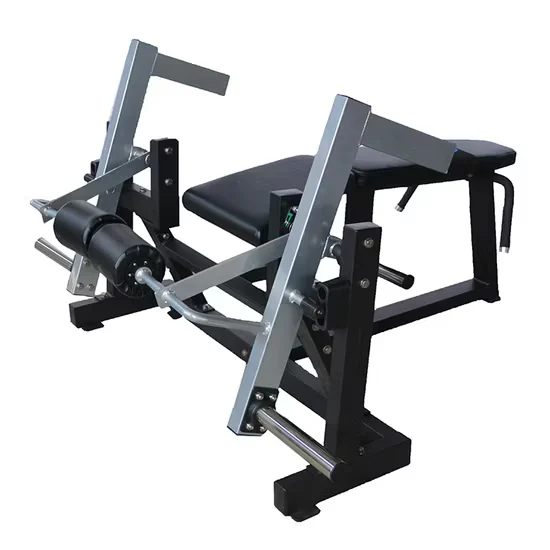
This unit targets the hip flexion and abdominal contraction movement pattern, occupying the gap between free-weight decline benches and cable-driven crunch machines. In a commercial floor plan, it pairs naturally with rotational torso machines and back extension stations to form a complete core circuit. The 98 kg steel frame anchors the unit against dynamic loading without requiring floor bolts, making it suitable for mid-zone placement where member traffic is highest. It accommodates users across a wide height and weight range thanks to the adjustable contact points, and the commercial abdominal work station manual resistance system delivers consistent tension regardless of user speed or body mass.
Continuous Operation and Facility Environment Requirements
A manual resistance station has no motor duty cycle to calculate and no thermal ceiling to monitor, which fundamentally simplifies deployment decisions. Because the unit draws zero electricity, it can be placed on any floor without dedicated circuit planning, including mezzanine levels and retrofit spaces where adding outlets is costly. The 2165 x 1020 mm footprint requires clearance on all sides for safe mounting and dismounting, and a rubber isolation mat is recommended on suspended floors to dampen the low-frequency thud that occurs during eccentric return phases [NEED_CITE: floor loading and vibration transmission for static strength equipment]. Ambient temperature and humidity have no effect on the resistance mechanism, so the unit performs identically in unconditioned warehouse gyms and climate-controlled hotel fitness rooms.
What the Steel Frame and Manual Resistance Path Actually Deliver
The 98 kg net weight reflects a fully welded steel chassis designed to resist torsional flex when a loaded user drives through the hip flexion arc. Lighter frames in this category tend to rock during explosive concentric phases, which compromises repetition quality and accelerates pivot bearing wear. The manual resistance path uses the user’s own body weight as the load variable, meaning resistance scales proportionally with the individual without requiring pin-stack selectors or magnetic brake calibration. The dual contact zones — abdominal pad and knee support — distribute force across two skeletal anchor points, reducing shear stress on the lumbar spine compared to floor-based crunch variations. This mechanical simplicity also means the commercial abdominal work station manual resistance unit has no consumable parts other than upholstery, keeping long-term operating costs predictable.
The Hidden Cost of Specifying Below Commercial Grade
Operators who install light-commercial or home-grade core stations in public facilities encounter a familiar failure sequence: pivot bearings develop play within months, vinyl upholstery splits along the stitch lines, and frame welds crack under repetitive off-axis loading. Each failure triggers a member complaint, a maintenance ticket, and eventually a full unit replacement that costs more than specifying commercial-grade equipment from the outset [NEED_CITE: lifecycle cost comparison of light-commercial versus commercial strength machines]. The downtime also leaves a gap in the core circuit, forcing members to improvise substitutes that may not target the same movement pattern.
Why This Product Line Holds Up Under Daily Abuse
Every unit in this cardio and strength family is tested for 10,000 hours of continuous operation before leaving the Shandong facility. The OS-H5074 benefits from the same sealed pivot bearings and reinforced weld protocols applied to the motorized product lines, ensuring structural consistency across the entire floor layout. Full OEM and ODM customization covers frame color, pad material, and brand embroidery, so the station matches the visual identity of the surrounding equipment. The in-house 3D layout service maps this unit’s footprint alongside adjacent machines to optimize member flow and sightlines. Backed by ISO 9001 manufacturing controls and 24/7 technical support, the platform removes procurement risk from multi-site rollouts.
Documentation & Test Records
- CE declaration of conformity for the OS-H5074 abdominal station
- EN 957 test report covering static and dynamic load performance
- ISO 9001 certificate validating manufacturing quality management
- Frame weld inspection and material thickness verification records
- Upholstery tear-resistance and abrasion durability test documentation
- Installation guide with floor clearance and anchor specifications
Installation, Commissioning & Maintenance
- Maintain minimum 600 mm clearance around the 2165 x 1020 mm frame perimeter for safe user access.
- Place on a level surface with a high-density rubber mat to absorb eccentric phase impact on suspended floors.
- Inspect pivot bearings and pad mounting bolts every 90 days under high-frequency commercial use.
- Clean vinyl contact surfaces daily with pH-neutral solution to prevent sweat-induced degradation.
- Verify frame welds and adjustment pin integrity during scheduled quarterly structural audits.
Planning Your Core Training Zone Procurement
Provide your floor plan dimensions and target unit count to receive a 3D layout that positions this station within a coherent core circuit. Specify daily member throughput so the support team can recommend placement density and adjacent equipment pairings. Confirm the deployment floor type and any overhead clearance constraints to finalize isolation mat and anchoring requirements. Indicate whether OEM branding or custom pad colorways are needed to align with your facility’s visual standards.
Frequently Asked Questions
Q: What maintenance advantages does a manual resistance abdominal station offer over motorized alternatives?
A: Without a motor, control board, or power cable, the failure points that generate service tickets are entirely absent. Maintenance reduces to periodic pivot bearing inspection, bolt torque verification, and upholstery cleaning. This eliminates electrical diagnostic labor and spare part inventories specific to drive systems, lowering annual upkeep cost and keeping the station available for member use continuously.
Q: How does the 98 kg steel frame affect floor loading and placement options?
A: The concentrated static load requires verification of floor slab capacity, especially on upper levels or suspended mezzanine structures. A high-density rubber isolation mat distributes point loading and dampens vibration during use. The engineering team can review structural drawings and recommend pad thickness to meet local building codes and prevent low-frequency noise transmission to rooms below.
Q: Can this abdominal station be integrated into a functional training circuit layout?
A: The 2165 x 1020 mm footprint allows placement alongside functional racks, cable crossovers, and free-weight zones without disrupting traffic lanes. The 3D layout service maps equipment spacing and member flow paths to ensure the station fits within a logical core-training sequence. Sightline and ventilation planning prevent the unit from becoming an underused island in high-density floor plans.
Q: What OEM customization options are available for this unit?
A: Frame powder-coat color, upholstery material and color, brand logo embroidery, and custom packaging are all configurable. Minimum order quantities are flexible to accommodate single-site boutique deployments and multi-site chain rollouts. The customization scoping phase confirms lead time and approves material samples before production begins.
Q: What is the recommended inspection cycle for high-frequency commercial environments?
A: Pivot bearings and pad mounting hardware should be checked every 90 days under continuous public use. Upholstery condition and frame weld integrity warrant quarterly review. Any adjustment mechanism or locking pin should be tested monthly to ensure positive engagement. These intervals are documented in the commissioning guide provided with each shipment.
![Hammer Strength Plate-Loaded ISO-Lateral Kneeling Leg Curl Gym Equipment [WARN] draft identifier mismatch](https://bicksport.com/wp-content/uploads/2026/08/hammer-strength-plate-loaded-iso-lateral-kneeling-leg-curl-gym-equipment-warn-draft-identifier-mismatch-247b68.webp)

