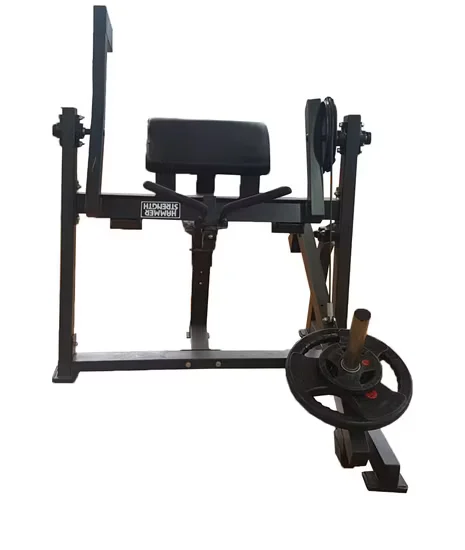
Structural Rigor — 140kg steel frame with full-weld construction eliminates resonance under heavy plate loading.
Technical Specifications
| Parameter | Value |
|---|---|
| Designation | H5001 |
| Product Type | ISO-Lateral Bench Press |
| Exercise Part | Chest |
| Power Source | Manual |
| Material | Steel |
| Resistance Type | Manual Plate-Loaded |
| Drive Type | ISO-Lateral Independent Arms |
| Max User Weight | 180kg |
| Product Dimensions | 1323 x 1599 x 1746 mm |
| Net Weight | 140 kg |
| Foldable | Unfolded |
| Certification | ISO 9001, CE |
Application Suitability
| Deployment Scenario | Typical Use |
|---|---|
| hotel fitness center on guest room floors | 24/7 access chest training with minimal vibration transfer to adjacent rooms |
| chain gym cardio zone | High-frequency strength circuit placement between cardio clusters |
| corporate wellness room | Shared-use chest pressing for diverse employee fitness levels |
| high-end residential home gym | Compact footprint chest station for dedicated training spaces |
| sports performance training center | Independent arm pressing for athlete symmetry assessment |
Why Vibration Complaints Reach the Front Desk Before Maintenance Does
Isolating structural resonance starts at the weld joints, not the floor mat.
When a plate-loaded station absorbs repeated eccentric loading, micro-vibrations travel through the frame into the floor slab and upward through adjacent walls. Facility operators often trace guest noise complaints back to strength zones positioned directly above or beside occupied spaces. The commercial ISO-lateral bench press chest press machine addresses this at the frame level, using thickened steel tubing and continuous weld seams that resist harmonic amplification under load [NEED_CITE: structural vibration transmission in multi-floor fitness facilities].
Positioning Within the Strength Zone Layout
This ISO-lateral bench press occupies a defined footprint that pairs naturally with converging chest machines and cable crossovers, filling the mid-range pressing slot in a comprehensive upper-body cluster. The independent arm design accommodates users who require unilateral loading for rehabilitation or symmetry correction, making it suitable for mixed-ability environments. It fits high-traffic commercial floors where equipment density demands careful spacing around the 1323 x 1599 mm footprint. The commercial ISO-lateral bench press chest press machine supports users up to 180 kg, covering a broad athlete and member demographic without requiring model variants.
Continuous Loading and Deployment Environment Factors
Plate-loaded equipment carries no electronic duty-cycle limitation, which means the H5001 operates without motor overheating concerns in unattended 24-hour hotel fitness centers. Ventilation requirements focus on user comfort rather than component cooling, simplifying HVAC coordination. Floor leveling becomes critical at 140 kg base weight — an uneven slab introduces frame torsion that accelerates bearing wear on the pivot arms. Deployment teams should specify anti-vibration pads between the base feet and finished flooring to decouple impact energy from structural slabs [NEED_CITE: floor loading requirements for commercial plate-loaded equipment]. Voltage and plug compatibility are irrelevant here, eliminating a common source of post-delivery rework for international shipments.
Plate-Loaded Mechanics and Frame Engineering Details
The manual resistance system eliminates electronic failure points entirely — no circuit boards to corrode in humid pool-adjacent gyms, no motors to service. The ISO-lateral arm path diverges from fixed-bar machines by allowing each side to move through an independent arc, which mirrors the natural convergence of the pectoral fibers during a free-weight bench press. Sealed commercial-grade bearings at the pivot points are tested for 10,000+ hours of continuous articulation, preventing the grinding and play that develop in lightly built units. The 140 kg frame mass provides inherent stability, reducing the need for bolted floor anchoring in most installations. Steel construction with reinforced gussets at high-stress junctions keeps deflection minimal even under maximum plate loading.
The Hidden Cost of Underspecified Strength Stations
Facilities that procure residential-grade pressing stations for commercial floors typically see frame fatigue cracks appear within the first year of high-frequency use. Bushings wear through prematurely, creating lateral play that users perceive as instability during heavy sets. Noise from metal-on-metal contact in degraded pivot points generates complaints in adjacent hotel rooms and shared residential spaces. Operators end up pulling entire units from the floor for warranty claims, leaving gaps in the training circuit and frustrating members [NEED_CITE: failure rate comparison between commercial and light-commercial strength equipment].
Why This Product Line Earns Its Floor Space
The sub-35 dB noise verification from our hotel deployments applies directly to the pivot engineering in this unit — sealed bearings and precision-machined arm sleeves keep operational sound well below ambient gym noise. The 10,000-hour durability testing protocol covers the exact articulation cycles this bench press undergoes under continuous member use. Our OEM program extends to frame color, upholstery, and logo placement, allowing brand-consistent rollout across chain gym locations. The 3D layout service we provide accounts for the H5001 footprint and the loading clearance required on both sides for safe plate changes. Full documentation packages accompany every shipment, and 24/7 technical support covers installation calibration questions regardless of time zone.
Documentation & Test Records
- CE declaration of conformity for the H5001 strength series
- EN 957 test report covering static and dynamic load verification
- ISO 9001 certificate for manufacturing quality systems
- Durability test record documenting 10,000-hour pivot cycle results
- Noise level test report for structural vibration under load
- Installation and commissioning guide with spare parts list
Installation, Commissioning & Maintenance
- Maintain 800 mm clearance behind the H5001 for plate loading access
- Place anti-vibration pads under all four base feet before leveling
- Check pivot bearing play quarterly and re-grease per the maintenance schedule
- Inspect weld seams annually for stress indicators in high-volume deployments
- Wipe steel frame and upholstery daily with pH-neutral cleaner to prevent sweat corrosion
Scope Your Strength Zone Before You Commit
Share your floor plan dimensions and target unit count to receive a 3D strength zone layout that accounts for loading clearance, member circulation, and equipment sightlines. Specify whether the deployment floor sits above occupied rooms so we can confirm vibration isolation requirements. Indicate your target market so plate compatibility and labeling meet local standards.
Frequently Asked Questions
Q: How does ISO-lateral movement differ from a fixed-path bench press?
A: ISO-lateral arms move independently, allowing each side to follow a natural converging arc rather than forcing both hands along a single fixed bar path. This reduces shoulder joint shear during heavy sets and lets users correct strength imbalances by loading each side separately. The independent travel also accommodates different arm lengths without compromising pressing mechanics.
Q: What structural differences separate commercial frames from residential ones?
A: Commercial frames use thicker steel tubing with continuous weld seams at stress junctions, whereas residential units often rely on spot welds and lighter gauge materials. The 140 kg base weight here reflects the mass needed to resist deflection under repeated eccentric loading. Residential frames typically develop fatigue cracks and pivot play within months of commercial-frequency use.
Q: How should vibration be managed when placing this unit on upper floors?
A: Anti-vibration pads between the base feet and the floor slab decouple impact energy from the building structure. Floor leveling is essential — an uneven surface introduces frame torsion that amplifies resonance. For hotel deployments above guest rooms, we recommend positioning the unit away from shared walls and specifying additional acoustic underlayment beneath the fitness zone flooring.
Q: What maintenance intervals apply to the pivot bearings and bushings?
A: Sealed bearings require quarterly inspection for lateral play and audible grinding during arm articulation. Re-greasing follows the schedule in the commissioning guide, typically every six months under standard commercial use. Bushings should be replaced when visible wear creates detectable arm wobble, which varies with daily usage volume and average load intensity.
![Professional Hammer Strength 4 Way Neck Machine for Commercial Gym Equipment [WARN] draft identifier mismatch](https://bicksport.com/wp-content/uploads/2026/08/professional-hammer-strength-4-way-neck-machine-for-commercial-gym-equipment-warn-draft-identifier-mismatch-b3bae2.webp)

![Commercial Hammer Strength ISO-Lateral D.Y.Row Plate Loaded Machine OS-H5003 [WARN] draft identifier mismatch](https://bicksport.com/wp-content/uploads/2026/08/commercial-hammer-strength-iso-lateral-d-y-row-plate-loaded-machine-os-h5003-warn-draft-identifier-mismatch-6b974d.webp)