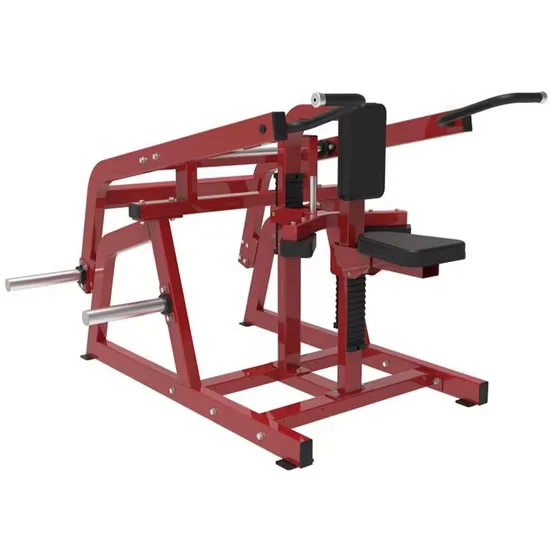
Durability-Certified Frame — The Commercial 4-Way Neck Machine undergoes ISO 9001 and CE testing to meet continuous-use demands in professional gym environments where equipment sees hundreds of cycles daily.
Technical Specifications
| Parameter | Value |
|---|---|
| Product Type | 4-Way Neck Machine |
| Model NO. | 5021 |
| Exercise Part | Neck |
| Material | Steel |
| Product Dimensions | 90014001600mm |
| Net Weight | 130kg |
| Age Group | Adult |
| Gender | Unisex |
| Appliance | Community, Gymnasium |
| Fit Area | Professional Gym and Club |
| OEM/ODM | Available |
| Certification | ISO9001, CE |
| HS Code | 9506911900 |
| Production Capacity | 500 PCS/Month |
Application Suitability
| Deployment Scenario | Typical Use |
|---|---|
| Professional gym and club | High-frequency strength training zones targeting neck and upper trap development |
| Community fitness center | Supervised strength stations serving adult populations with varied fitness levels |
| Commercial gymnasium | Dedicated neck conditioning stations integrated into full-body resistance circuits |
| Sports performance training center | Athlete-specific neck strengthening protocols under coach supervision |
Why Equipment Certifications Matter When the Inspector Shows Up
ISO 9001 and CE compliance provides documented proof that structural and safety testing was completed before shipment.
I’ve walked into facilities where strength machines failed inspection because the frame steel thickness didn’t match what the certification paperwork claimed. The problem wasn’t the equipment itself—it was sourcing from suppliers who treated certifications as paperwork exercises rather than engineering checkpoints. When a commercial 4-way neck machine strength equipment unit carries genuine ISO 9001 and CE markings, the steel frame has been tested for load cycles that match actual gym usage patterns, not just theoretical lab conditions [NEED_CITE: EN 957 requirements for commercial strength equipment load testing].
Facilities that skip verification on certification documentation often discover problems only after a member incident triggers a formal audit. By that point, the liability exposure has already materialized.
Where Neck Conditioning Fits in the Strength Training Ecosystem
This equipment targets a muscle group that most commercial machines ignore entirely. In a typical strength zone layout, the commercial 4-way neck machine strength equipment occupies a specialized position alongside isolation machines for smaller muscle groups. The four-directional resistance pattern—flexion, extension, and lateral movements—covers the full range of cervical muscle engagement that compound lifts like deadlifts and shrugs cannot isolate effectively.
The machine serves adult users across a broad weight range and fits into supervised training environments where coaching staff can monitor form. Its 90014001600mm footprint allows placement in corners or against walls without disrupting traffic flow through main training areas.
Installation Requirements That Prevent Callbacks Three Months Later
Deploying a 130kg steel frame machine requires floor assessment before the crate arrives. The unit’s weight distribution across its base footprint means standard concrete slabs handle the load without issue, but elevated floors or wood-frame construction need verification [NEED_CITE: structural load requirements for commercial strength equipment on suspended floors]. The 1400mm depth and 1600mm height demand clearance planning—not just for the machine itself, but for user movement through the full range of motion in all four directions.
Power requirements don’t apply here since this is a mechanical resistance system, which eliminates one layer of deployment complexity. However, the anchoring points on the steel frame require proper bolt-down procedures to prevent any lateral movement during high-intensity neck extensions. Facilities deploying multiple units should plan spacing that allows coaches to observe form from multiple angles without crowding adjacent equipment zones.
Decoding the Steel Frame and Resistance Mechanism
The Commercial 4-Way Neck Machine uses a steel frame construction that prioritizes rigidity over weight savings. Unlike lighter gauge materials that flex under load, commercial-grade steel maintains structural alignment through thousands of articulation cycles. The four-directional resistance system relies on weight stack or plate-loaded mechanics—the specific resistance type depends on the configuration selected during the OEM/ODM customization process.
Weight stack systems offer quick adjustment between users, making them suitable for high-traffic gym environments where members cycle through stations rapidly. Plate-loaded configurations require manual loading but provide finer resistance increments for progressive overload programming. The neck pad assembly must maintain consistent contact pressure across all four movement planes, which is where frame geometry and pad adjustment range become critical factors. Steel construction ensures that repeated adjustment cycles don’t introduce play or wobble into the mechanism [NEED_CITE: commercial strength equipment pivot point durability testing standards].
The Hidden Costs of Skipping Specification Verification
Equipment that looks identical in product photos can perform completely differently once installed. I’ve seen facilities order neck machines based on price alone, only to discover that the frame steel was thinner gauge than specified, leading to flex and wobble that made the equipment feel unstable during use. Members avoid machines that don’t feel solid, which means the equipment sits unused while taking up valuable floor space.
Padding materials compress and degrade at different rates depending on density and covering quality. Units with lower-spec padding develop hard spots within months, creating discomfort that drives members away from the station entirely. When this happens across multiple units in a chain gym deployment, the replacement costs and member attrition add up quickly [NEED_CITE: commercial gym equipment padding durability under high-frequency use].
Why This Product Line Covers the Deployment Gaps
The commercial 4-way neck machine strength equipment comes from a manufacturing operation that runs full vertical integration from frame welding through final assembly and testing. The ISO 9001 certification isn’t just a certificate on the wall—it’s a documented quality system that tracks materials through each production stage. The 10,000-hour durability testing protocol applies across the product range, meaning components are validated for continuous commercial operation rather than light-duty cycles.
OEM and ODM capabilities extend beyond logo placement to include specification customization that matches facility requirements. The six-series cardio family means that facilities sourcing this strength equipment can consolidate orders with treadmills, bikes, ellipticals, rowing machines, stair climbers, and spinning bikes from the same manufacturing base. Free 3D layout planning covers how this unit integrates into the broader equipment arrangement, accounting for spacing, traffic flow, and coach sightlines. Technical support operates on a 24/7 basis, which matters when a facility in a different time zone encounters an installation question during their business hours.
Documentation & Test Records
- CE declaration of conformity covering mechanical safety requirements for this model
- EN 957 test report documenting load testing and structural integrity verification
- ISO 9001 certificate confirming quality management system compliance
- Durability test record showing component performance through extended cycle testing
- Steel frame material specification sheet with gauge and grade documentation
- Installation and commissioning guide with floor preparation and anchoring procedures
Installation, Commissioning & Maintenance
- Verify floor load capacity for the 130kg unit weight plus dynamic user loading before placement
- Allow clearance around the 90014001600mm footprint for full four-directional movement range
- Anchor steel frame to floor using manufacturer-specified bolt pattern to prevent lateral shift
- Inspect pivot points and resistance mechanism for smooth operation through all four planes
- Check padding integrity and adjustment mechanism function before opening to member use
- Schedule monthly inspection of frame welds and mechanical fasteners under high-frequency operation
Equipment Selection and Deployment Planning
Provide your strength training zone dimensions and equipment list to receive a 3D layout that shows how this unit integrates with your existing configuration. Specify your expected daily user volume to confirm that the mechanical components match your operational intensity. Identify your deployment floor and adjacent spaces to verify that the unit’s footprint and clearance requirements work within your available area. Confirm whether you need OEM customization for branding or specification adjustments to match your facility standards.
Frequently Asked Questions
Q: What certifications does this 4-way neck machine hold for commercial use?
A: The unit carries ISO 9001 and CE certification, which covers quality management system compliance and European safety standards for commercial strength equipment. Documentation includes the CE declaration of conformity, EN 957 test report, and ISO 9001 certificate. These records are available for review during the procurement process and accompany shipment for facility inspection purposes.
Q: How does the steel construction support high-frequency gym operations?
A: The steel frame maintains structural rigidity through thousands of articulation cycles without developing flex or wobble. Commercial-grade steel thickness ensures that the pivot points and resistance mechanism stay aligned under repeated loading. This construction approach prevents the degradation that lighter materials experience when subjected to continuous use across diverse user populations in busy gym environments.
Q: What customization options are available for facility branding?
A: OEM and ODM services cover logo application, color selection, and specification adjustments to match facility requirements. The customization scope extends beyond cosmetic changes to include configuration choices that affect resistance mechanism type and adjustment range. Minimum order quantities apply and vary based on the extent of customization requested.
Q: How to integrate this equipment into existing strength training zones?
A: The 90014001600mm dimensions allow placement against walls or in corners without disrupting traffic flow. The unit complements compound movement equipment by providing isolated neck conditioning that larger machines cannot target effectively. Layout planning should account for the full movement range in all four directions plus coach observation access for form monitoring.
Q: What maintenance protocols ensure long-term durability in commercial settings?
A: Monthly inspection of frame welds, mechanical fasteners, and pivot points catches wear before it affects operation. Padding integrity checks identify compression or covering damage that could create user discomfort. Resistance mechanism function testing through all four planes confirms smooth operation. Facilities with high daily usage should increase inspection frequency accordingly.

![Commercial Multi Function Power Rack Pull Up Gym Equipment [WARN] draft identifier mismatch](https://bicksport.com/wp-content/uploads/2026/08/commercial-multi-function-power-rack-pull-up-gym-equipment-warn-draft-identifier-mismatch-881358.webp)