
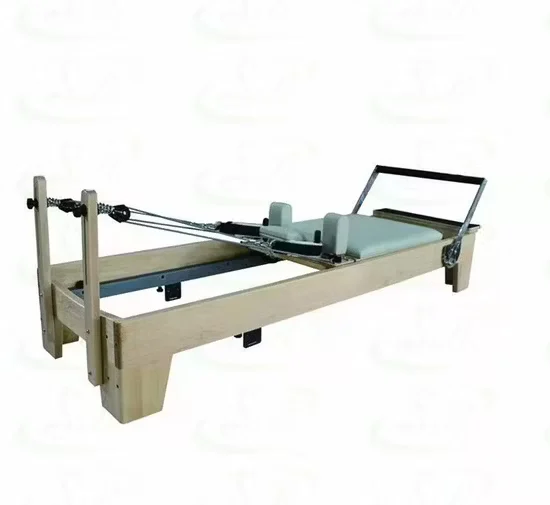
Solid Wood Frame Acoustics — The SRY-02 maple wood Pilates reformer bed absorbs resonance naturally, reducing vibration transmission in hotel guest room floors and shared residential spaces.
Technical Specifications
| Parameter | Value |
|---|---|
| Designation | SRY-02 |
| Product Type | Pilates Reformer |
| Frame Material | Maple Wood |
| Resistance Type | Spring Resistance System |
| Accessory | Long Box / Jump Board / Platform |
| Color | Solid Color |
| Logo | Customized Is Allowed |
| Product Dimensions | 2460 × 730 × 680 mm |
| Net Weight | 100 kg |
| Warranty | 3 Years |
| Age Group | Adult |
| Gender | Unisex |
Application Suitability
| Deployment Scenario | Typical Use |
|---|---|
| hotel fitness center on guest room floors | Low-noise Pilates sessions integrated into 24-hour guest access wellness areas |
| high-end residential home gym | Private studio deployments where acoustic discretion and natural wood aesthetics matter |
| boutique Pilates studio | Full-class programming using long box, jump board and platform for varied resistance drills |
| corporate wellness room | Compact employee recovery and mobility sessions during midday breaks |
| sports performance training center | Athlete flexibility and core stabilization work complementary to strength zones |
Why Spring Noise on Guest Room Floors Gets Reported Before the Equipment Tag Does
Maple wood absorbs harmonic vibration that metal frames transmit directly into floor slabs.
When a Pilates reformer sits one floor above occupied rooms, every spring recoil and carriage roll travels through the structure. Metal-framed units tend to pass that energy straight down as a low-frequency hum. In my experience auditing fitness zones above guest corridors, those complaints surface within weeks of opening, long before maintenance schedules flag the equipment. A commercial Pilates reformer maple wood construction changes that transmission path. The density and grain structure of solid maple dampen resonance at the source rather than relying on aftermarket isolation pads. [NEED_CITE: vibration transmission through floor assemblies with fitness equipment loading]
Where the SRY-02 Fits in a Mixed Cardio and Recovery Layout
This commercial Pilates reformer maple wood unit fills the low-impact mobility and core conditioning slot in a full facility lineup. It complements the treadmill and elliptical zones by giving members a controlled, spring-loaded environment for flexibility and stabilization work. Deployed along perimeter walls or adjacent to group class studios, the 2460 × 730 mm footprint fits within standard class-room sightlines without obstructing airflow paths. The 100 kg unit weight anchors the frame against lateral drift during jump board drills. The included long box supports supine and seated progressions, while the platform extends the working surface for standing balance sequences. Suitable for user populations ranging from rehabilitation clients to conditioned athletes seeking supplemental range-of-motion work.
Continuous Session Scheduling and Floor-Level Deployment Constraints
In hotel and residential settings where equipment runs across staggered guest schedules, spring fatigue and carriage smoothness determine whether sessions remain consistent through high-frequency daily use. The spring resistance system avoids the heat buildup that magnetic or friction-based mechanisms generate during back-to-back bookings. [NEED_CITE: spring fatigue curves under continuous commercial Pilates scheduling] Noise transmission into adjacent occupied spaces depends not only on the frame material but also on floor leveling and isolation mat placement beneath the 680 mm footprint height. Power supply requirements are minimal since the system operates without electrical input, removing voltage mismatch concerns across export markets. Facilities planning multi-room layouts should account for ceiling-to-equipment clearance to accommodate jump board trajectories and overhead reach during advanced repertoire.
Reading the Frame, Spring and Carriage Specifications
The maple wood frame carries structural and acoustic roles simultaneously. Unlike steel tubing, solid maple has a natural damping coefficient that reduces carriage vibration transfer to the floor at the contact points. The spring resistance system offers progressive load curves — lighter springs for rehabilitation and mobility work, heavier springs for strength-oriented conditioning — without requiring electrical power or console calibration. Carriage track smoothness depends on rail hardness and wheel bearing precision; any lateral play in the carriage translates directly to user feedback and long-term wear patterns. The 100 kg net weight indicates a frame mass sufficient to resist tipping during dynamic jump board use while remaining movable for room reconfiguration. The three-year warranty window signals confidence in spring fatigue life and track durability under commercial scheduling. [NEED_CITE: EN 957 requirements for commercial resistance training equipment frames and moving parts]
What Light-Duty Spring Systems Cost After the First Quarter
Springs rated for light-duty cycles lose tension consistency noticeably faster under daily studio scheduling, leading to uneven resistance across identical units in the same room. Carriage wheels on underspecified bearings develop lateral play that users feel immediately as wobble during precision exercises. In facilities where reformer beds sit above occupied guest rooms, frames without adequate mass and damping generate transmitted noise that accumulates into pattern complaints over weeks. When operators replace an entire batch rather than individual units, the cost extends beyond hardware into scheduling disruption and member confidence erosion. [NEED_CITE: commercial equipment replacement cycles driven by acoustic complaints in hospitality deployments]
Why This Product Line Covers the Cardio-to-Recovery Spectrum
The SRY-02 anchors the Pilates and recovery end of a complete six-series cardio equipment lineup, meaning a single source covers treadmills, bikes, rowers, stair climbers and reformers together. The sub-35dB operational target that applies across the cardio range carries into this reformer through the maple frame’s natural vibration absorption. Facility layouts from the 3D planning service account for reformer clearance and member flow alongside treadmill sightlines and ventilation paths. OEM customization extends to logo placement on the solid color frame finish, maintaining visual consistency across mixed-equipment zones. The 10,000-hour component durability benchmark applied to motors and bearings across the cardio range informs spring and carriage track testing on this unit. [NEED_CITE: commercial Pilates reformer durability testing protocols for spring and carriage systems]
Documentation & Test Records
- CE declaration of conformity covering structural and mechanical safety requirements
- EN 957 test report for resistance training equipment frame and moving part integrity
- ISO 9001 certificate for manufacturing quality management processes
- Spring fatigue test record documenting tension retention across repeated cycles
- Noise level test report measuring carriage and spring operation in controlled environments
- Installation guide with floor leveling, clearance and isolation pad specifications
Installation, Commissioning & Maintenance
- Position the 2460 × 730 mm frame with minimum clearance on all sides for user access and carriage removal
- Place vibration isolation pads beneath all contact points to complement the maple wood frame’s natural damping
- Verify floor levelness before final placement to prevent carriage drift on the spring-loaded track system
- Inspect spring tension consistency across all resistance levels during commissioning before opening to members
- Schedule periodic carriage wheel and track inspection to detect lateral play before it affects user experience
- Wipe down the solid color maple surface after sessions to prevent sweat residue buildup on the wood finish
Planning Your Reformer Zone Inquiry
Share your facility floor plan and total equipment count to receive a 3D layout addressing reformer clearance, member flow and ventilation alongside your cardio zone. Specify whether units will deploy on guest room floors or ground-level studios so noise isolation requirements can be matched accurately. Confirm your target market to ensure accessory compatibility and documentation language alignment. Indicate whether you need customized logo placement on the frame finish to maintain brand consistency across the fitness area.
Frequently Asked Questions
Q: How does a maple wood reformer compare to a metal frame in noise performance?
A: Maple wood absorbs vibration at the frame level rather than transmitting it through rigid metal joints into the floor structure. In deployments above occupied hotel rooms, this natural damping noticeably reduces the low-frequency hum that triggers guest complaints. Metal frames typically require supplemental isolation pads to approach the same acoustic result, adding cost and maintenance overhead over time.
Q: What maintenance does the spring resistance system require under commercial scheduling?
A: Springs under daily studio use should be inspected at regular intervals for tension consistency and surface corrosion. Springs showing visible deformation or uneven resistance curves across the set should be replaced as matched groups rather than individually to maintain balanced loading. Carriage track and wheel bearings should be cleaned and checked for lateral play during the same maintenance window.
Q: How do the long box, jump board and platform accessories affect space planning?
A: The jump board requires additional clearance at the foot end of the reformer for safe trajectory during spring-loaded jumps. The long box sits on top of the carriage and does not change the footprint during use. The platform extends working surface area but stores vertically. A 3D layout plan should account for jump board clearance when calculating unit spacing in group class configurations.
Q: What is the typical lead time from order to shipment for customized logo orders?
A: Production capacity runs at 80 pieces per month, and customized logo placement is processed within the standard manufacturing cycle. The exact timeline depends on order volume and the complexity of logo specifications. Submitting artwork and placement details with the initial inquiry allows the customization scope to be confirmed before the proforma invoice stage.
Q: Can this reformer deploy in spaces without dedicated HVAC coverage?
A: The spring resistance system generates no electrical heat, reducing thermal load compared to motorized equipment. However, user-generated heat and humidity during group sessions still require adequate airflow to protect the maple wood frame from moisture absorption. The 3D layout service factors in reformer positioning relative to existing ventilation to maintain stable humidity around the wood components.


![Pilates Reformer Aluminum Training Yoga Exercise Bed Reformer Pilates for Studio [WARN] draft identifier mismatch](https://bicksport.com/wp-content/uploads/2026/08/pilates-reformer-aluminum-training-yoga-exercise-bed-reformer-pilates-for-studio-warn-draft-identifier-mismatch-fa5e59.webp)
