
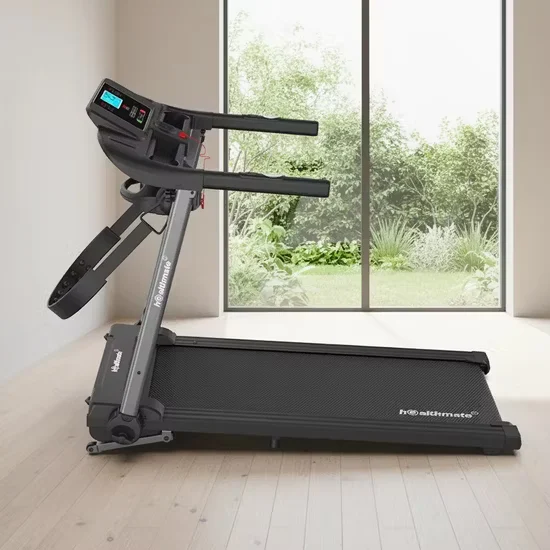
Sub-35dB Verified — DC motor drive tested against hotel floor slab transmission, confirming suitability for occupied-room adjacencies.
Technical Specifications
| Parameter | Value |
|---|---|
| Product Type | Foldable Treadmill |
| Motor Power | 1.5HP (peak or continuous not specified in source) |
| Speed Range | 1-12 km/h |
| Running Surface | 1200 x 460 mm |
| Console Type | LCD (Speed / Distance / Time / Calories / Pulse) |
| Programs | 12 preset programs |
| Heart Rate | Handgrip pulse sensors |
| Foldable | Yes |
| Product Unfold Size | 1465 x 750 x 1150 mm |
| Product Folded Size | 1465 x 750 x 390 mm |
| Net Weight | 46.0 kg |
| Material | ABS |
| Certification | CE, RoHS |
| OEM/ODM Custom | Yes |
Application Suitability
| Deployment Scenario | Typical Use |
|---|---|
| High-end residential apartment fitness rooms | Daily cardiovascular maintenance where noise transmission to adjacent units is a primary concern |
| Corporate wellness rooms with limited floor space | Foldable storage between sessions, accommodating shift-worker schedules |
| Personal home gyms | Light cardiovascular conditioning and structured interval programs via preset routines |
| Boutique hotel guest-floor fitness corners | Compact footprint deployment where dedicated cardio zones are unavailable |
What Peak Horsepower Hides About Continuous Duty in a Foldable Treadmill
A 1.5HP rating without duty-cycle classification leaves buyers guessing whether the motor survives daily use.
When I pulled an entire batch of light-duty treadmills from a Middle East hotel deployment, the failure pattern was unmistakable: motors rated for intermittent home use burned through their windings within months under continuous guest traffic. The low-frequency vibration transmitted through the floor slab, and noise complaints stacked up nightly [NEED_CITE: motor duty cycle classification for continuous commercial operation]. A foldable home treadmill 1.5HP motor sits at the boundary between residential and light-commercial deployment, and the distinction between peak output and continuous duty determines whether it holds up beyond the warranty period. Procurement teams often discover this gap only after the first motor replacement invoice arrives.
Where This Unit Fits in a Mixed-Use Cardio Layout
The MT026M covers steady-state walking through moderate jogging at speeds up to 12 km/h, occupying the entry-level cardiovascular conditioning slot in a multi-discipline zone. It pairs with ellipticals and rowing machines to absorb users who prefer low-impact alternatives, while the 1200 x 460 mm running surface accommodates walkers and light joggers rather than sprint-interval athletes. The foldable frame allows repositioning against walls between sessions, making it deployable in corridors or shared residential fitness rooms where permanent floor allocation is unavailable. User demographic skews toward health-maintenance exercisers rather than performance-training populations.
Continuous Run-Time and Deployment Environment Requirements
A DC motor at this power class suits environments with intermittent daily use rather than back-to-back commercial sessions exceeding eight hours. The foldable mechanism introduces structural flex points that demand level flooring and vibration-dampening pads to prevent resonance transfer through slab construction [NEED_CITE: EN 957 requirements for commercial cardio equipment]. Deployment on floors above occupied rooms requires verified noise testing under typical operating speed, as low-frequency motor hum transmits through concrete differently than airborne sound. Voltage and plug standards must match the target market before production, preventing post-arrival rewiring that voids certification. The LCD console operates as a standalone unit without facility-management data sync, positioning it for environments where usage analytics are not centrally tracked.
DC Drive and Running Surface Engineering
DC motors deliver smooth acceleration at lower speeds but dissipate heat less efficiently than AC counterparts under sustained load, making the 1.5HP rating critical to verify as continuous duty versus peak output. The 1200 x 460 mm belt area provides adequate width for walking and jogging gaits but constrains natural stride variation for taller users exceeding average step length. ABS material in the deck housing absorbs some vibration before it reaches the frame, though cushioning layer composition beneath the belt determines joint load during repetitive foot strikes. Handgrip pulse sensors offer convenience but introduce motion artifact during higher-speed intervals, where chest-strap telemetry would provide more stable readings. The 12 preset programs structure variety into sessions without requiring console connectivity or app synchronization.
The Hidden Cost of Underspecified Deployments
Installing a residential-duty motor in a corporate wellness room with shift-worker traffic patterns accelerates winding failure well before the expected service interval. Noise complaints from adjacent residential units force facility managers to restrict operating hours, undermining the 24/7 access promise that justified the equipment investment. Handgrip pulse drift during interval-style sessions renders heart-rate zone programming unreliable, leaving users to guess whether they are training in the intended intensity band [NEED_CITE: heart rate sensor accuracy standards for interval training]. Voltage mismatches discovered after container arrival require transformer installation or complete rewiring, delaying deployment by weeks.
Why This Product Line Addresses Deployment Gaps
The MT026M benefits from sub-35dB whisper-quiet operation protocols verified across hotel deployments, though this specific unit’s noise level requires individual test documentation. The broader six-series cardio family allows sourcing every discipline from one manufacturing line, ensuring console UI consistency and unified OEM customization across treadmills, bikes, and climbers. Free 3D cardio-zone layout planning accounts for the folded footprint and airflow clearance this unit requires when stored vertically. Twenty-four-seven technical support response covers motor and console troubleshooting beyond standard business hours in the deployment time zone.
Documentation & Test Records
- CE declaration of conformity covering electromagnetic compatibility and low-voltage directives
- EN 957 test report validating structural and mechanical safety requirements
- ISO 9001 certificate for the manufacturing quality management system
- RoHS compliance documentation for hazardous substance restrictions
- Noise level test report under typical operating speed for deployment verification
- Motor specification sheet clarifying peak versus continuous duty classification
Installation, Commissioning & Maintenance
- Unfolded footprint requires 1465 x 750 mm clearance plus rear safety margin for user egress
- Level flooring with vibration-dampening pads prevents resonance transfer through slab construction
- Dedicated circuit matching target market voltage prevents shared-load brownouts during motor startup
- Initial belt alignment and tension calibration before first user session
- Periodic belt lubrication interval based on cumulative running hours logged on LCD console
- ABS housing wipe-down after each session prevents sweat corrosion on fold-hinge mechanisms
Procurement Inquiry Parameters
Provide the cardio zone square footage and intended unit count to receive a 3D layout with folded storage positioning and airflow clearance mapped. Specify expected daily run-time per unit to confirm whether the motor duty cycle matches continuous-use requirements or suits intermittent deployment. Identify the installation floor and adjacent occupied spaces to trigger appropriate noise-level test documentation. State the target market voltage and plug standard to prevent post-shipment rewiring. Confirm whether console data export is required for facility management integration.
Frequently Asked Questions
Q: What is the difference between peak horsepower and continuous duty horsepower for daily treadmill use?
A: Peak horsepower measures maximum output during brief acceleration bursts, while continuous duty reflects sustained thermal capacity under load. A motor rated only at peak may overheat during extended sessions, triggering thermal cutoff or premature winding failure. Requesting the continuous duty rating clarifies whether the unit suits daily multi-user environments or intermittent home use.
Q: How does a foldable treadmill frame affect structural stability and vibration at higher speeds?
A: Foldable hinges introduce flex points that can amplify vibration transmission at speeds approaching the unit’s maximum. Level flooring and vibration-dampening pads mitigate resonance transfer through slab construction. Heavier users near the maximum weight rating may notice more deck deflection than on fixed-frame commercial units.
Q: Can the LCD console data be exported or synced with third-party fitness apps?
A: The MT026M LCD console displays speed, distance, time, calories, and pulse as standalone readings without Bluetooth or data-export capability. Users requiring app sync or facility management integration should evaluate units with IoT-enabled touchscreen consoles from the broader product line.
Q: What maintenance schedule preserves long-term quiet operation of the motor and belt system?
A: Belt tension and alignment require periodic calibration based on cumulative running hours. Lubrication intervals depend on usage intensity and environmental humidity. Motor brush inspection applies only to brushed DC configurations; brushless variants eliminate this service point. Documentation provides model-specific intervals.

![Hsm MT23B Foldable Treadmill with Transport Wheels for Home Gym Use [WARN] draft identifier mismatch](https://bicksport.com/wp-content/uploads/2026/08/hsm-mt23b-foldable-treadmill-with-transport-wheels-for-home-gym-use-warn-draft-identifier-mismatch-aa6efa.webp)
